Salesforce
Salesforce World Tour London Takeaways: Fix the Messy Middle in RevOps, Marketing and Field Service
Last updated: 3 July 2026
Salesforce World Tour London landed at ExCeL on Thursday 4 December 2025, and the headline theme was clear: become an "agentic enterprise". In normal English, that means using software "agents" that can take action (not just answer questions), as long as you give them good data and clear guardrails.
I spent the day jumping between the keynote, Revenue Operations, Field Service, and Marketing Cloud sessions. Across all of them, the message was consistent:
- •Agentic tech is exciting
- •But it only works when you fix the messy middle
- •And the messy middle is nearly always a data and handover problem
If you are a CIO, COO, VP RevOps, Marketing Ops leader, or Service leader, this matters because your biggest operational pain is rarely about effort. It is usually about broken handovers between tools, teams, and processes.
Quick next step before you read on
If you want to turn "agentic tech" into something real, without committing to a big programme, this is the fastest route I've found:
Start with one controlled Agentforce pilot, one use case, with guardrails and measurable outcomes.
See the fixed-price offering hereWhat "agentic" actually meant at World Tour London
There's a lot of noise around AI right now, so here's the cleanest definition I can give you:
An agent is software that can do work, not just talk about work
Salesforce describes Agentforce as an "agentic platform" where you can build and deploy digital labour across channels and systems.
The practical bit is this: an agent needs boundaries. If you let it roam, you will not get results, you will get risk.
In the simplest terms, you want an agent that can do things like:
- •triage and route cases
- •draft customer updates
- •summarise work orders
- •help schedule appointments
- •take a clear action inside a process
…and only inside the permissions you define.
Salesforce's own explanation of how Agentforce works breaks it down into what agents need to get work done (data plus reasoning plus actions).
Why this matters for leaders
Because "agentic tech" does not replace delivery discipline. It increases the need for it.
If your data is messy and your process is unclear, agentic tech does not fix it. It speeds it up.
The big theme: disconnected data creates disconnected work
One slide hit hardest because it was so simple:
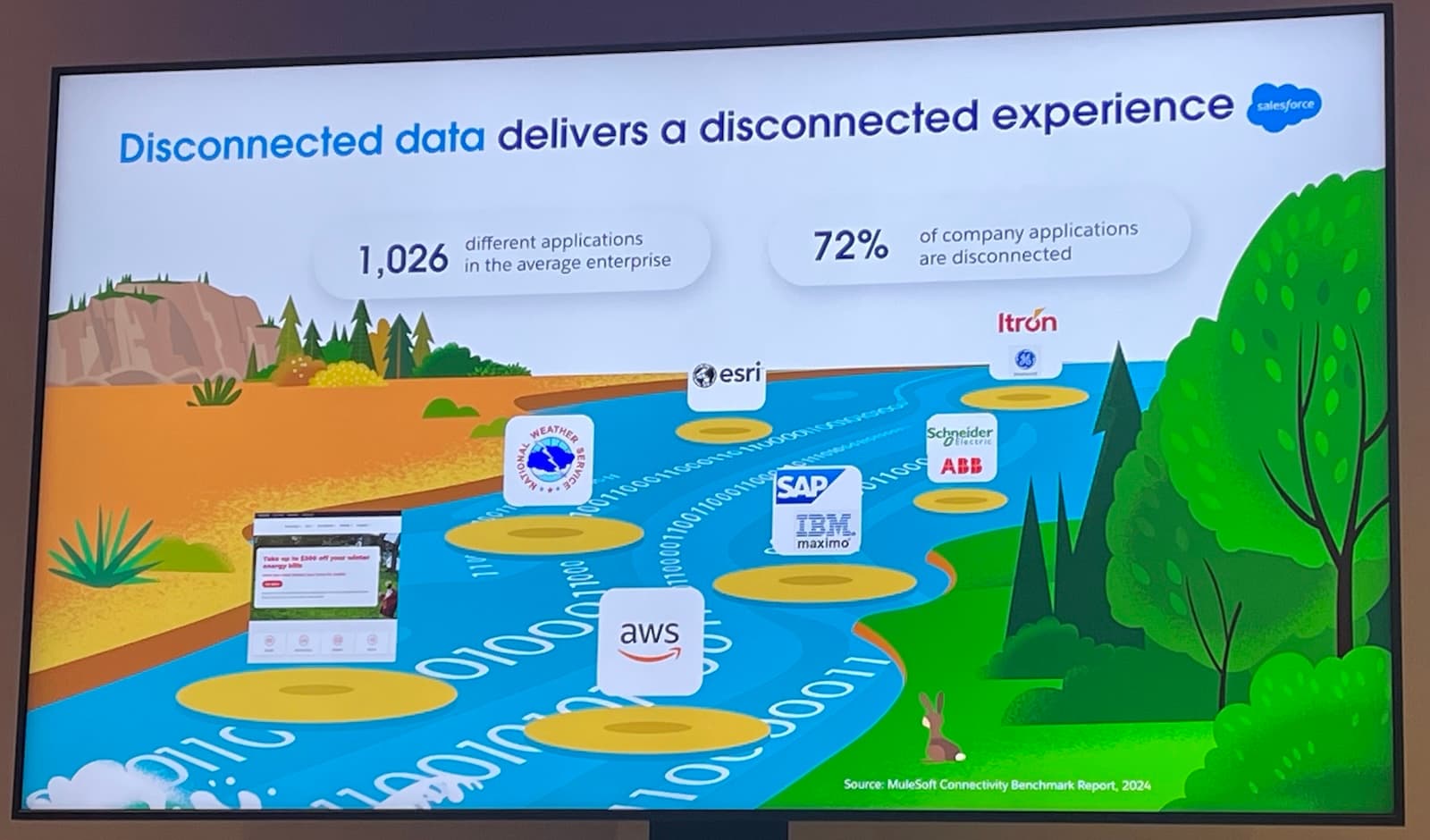
Disconnected data delivers a disconnected experience.
It also put numbers on it: 1,026 applications in the average enterprise, and 72% of company applications disconnected.
Disconnected data delivers a disconnected experience
You do not need to be technical to feel this. Disconnected work looks like:
- •marketing emails that do not match what sales is doing
- •quoting that depends on someone's spreadsheet
- •service teams arriving without the right info (or the right part)
- •reporting that turns into a monthly panic
Quick diagnostic: are you dealing with disconnected work?
| What you see | What's probably happening underneath | What it costs you |
|---|---|---|
| People re-key customer info | No shared source of truth | Errors plus wasted time |
| "We'll get back to you" becomes normal | Info is hard to find or not trusted | Slow decisions, slow deals |
| Dashboards spark arguments | Definitions differ by team | Meetings replace action |
| Customers get different answers across channels | Data and knowledge are not consistent | Trust drops |
| Small changes take weeks | Work crosses too many systems | Hidden cost and burnout |
If this table made you wince, you do not need a 12-month AI programme. You need one tight pilot that proves value with guardrails.
Start hereThe messy middle: where revenue slows down and trust leaks
The keynote framed revenue in a way that's useful for execs:
Revenue is the only process that unites every department in an organisation.
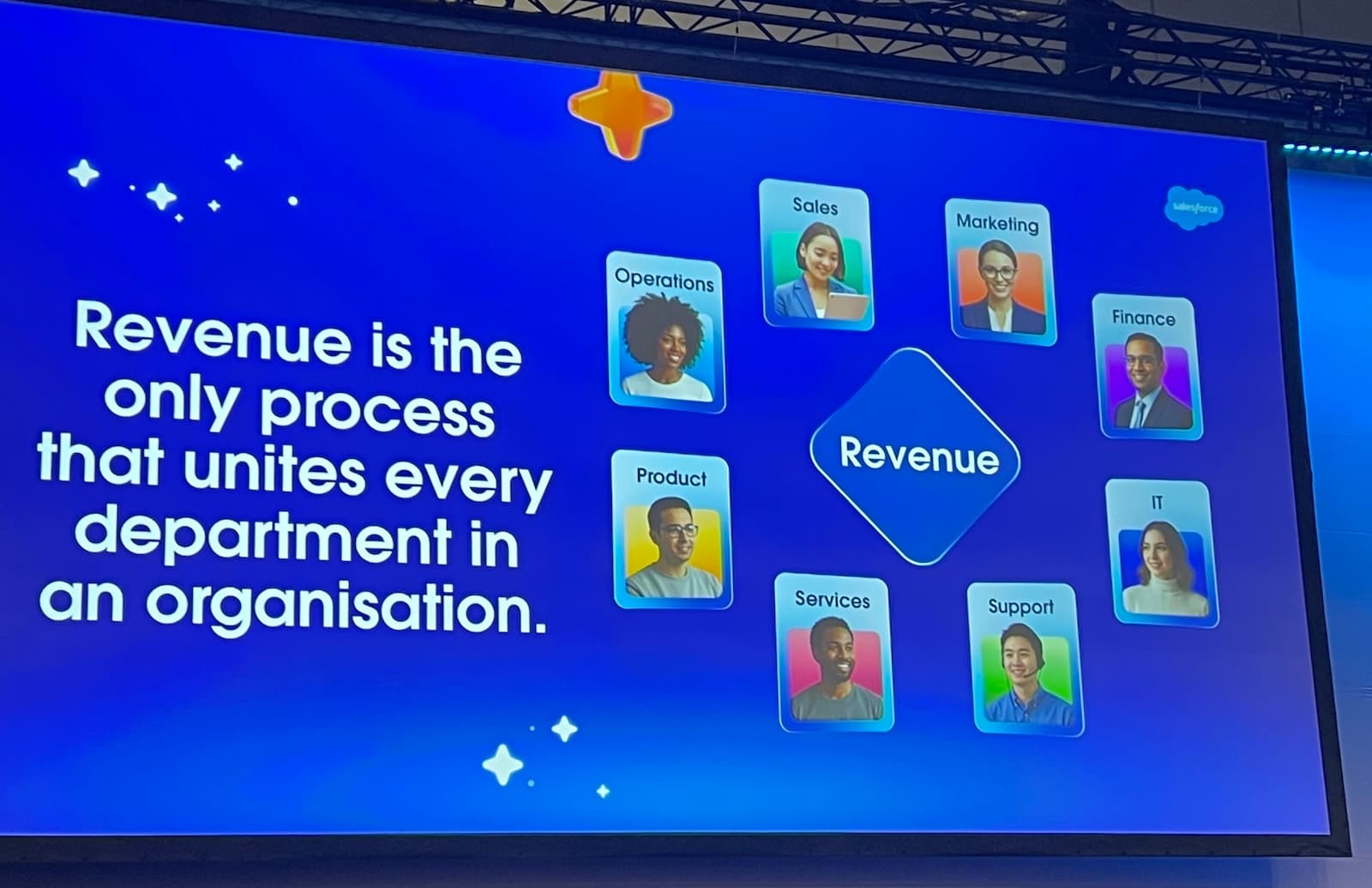
Revenue unites every department
That's why it breaks first when handovers are messy.
Another keynote slide showed the core problem visually: CRM on one side, ERP on the other, and then a messy middle of disconnected processes in between.
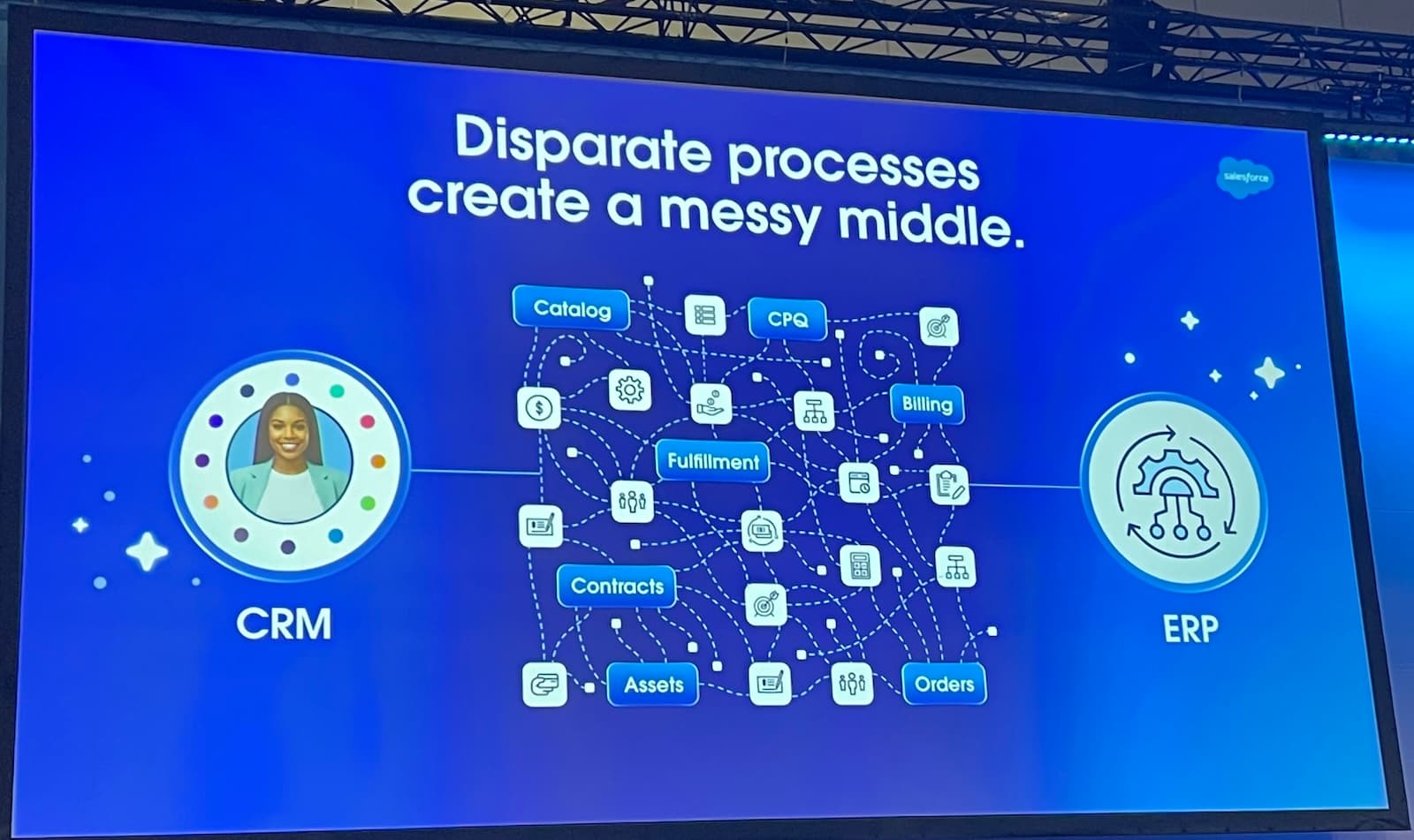
The messy middle between CRM and ERP
A simple way to find your messy middle in 30 minutes
Pick one revenue stream (renewals is a good one because it is frequent and measurable), then answer:
- Where does intent start (form, call, partner, inbound email)?
- Where is the quote created, and who changes it?
- Where do approvals happen (and how often is it email)?
- Where does a "deal" turn into an "order"?
- Where is the invoice created?
- Where do disputes and credit notes begin?
Now circle where work leaves the system and becomes human glue.
That is your messy middle.
The four questions that cut through confusion
Another slide boiled it down to four simple questions: what you sell, how you sell, how you go to market, and how you market.
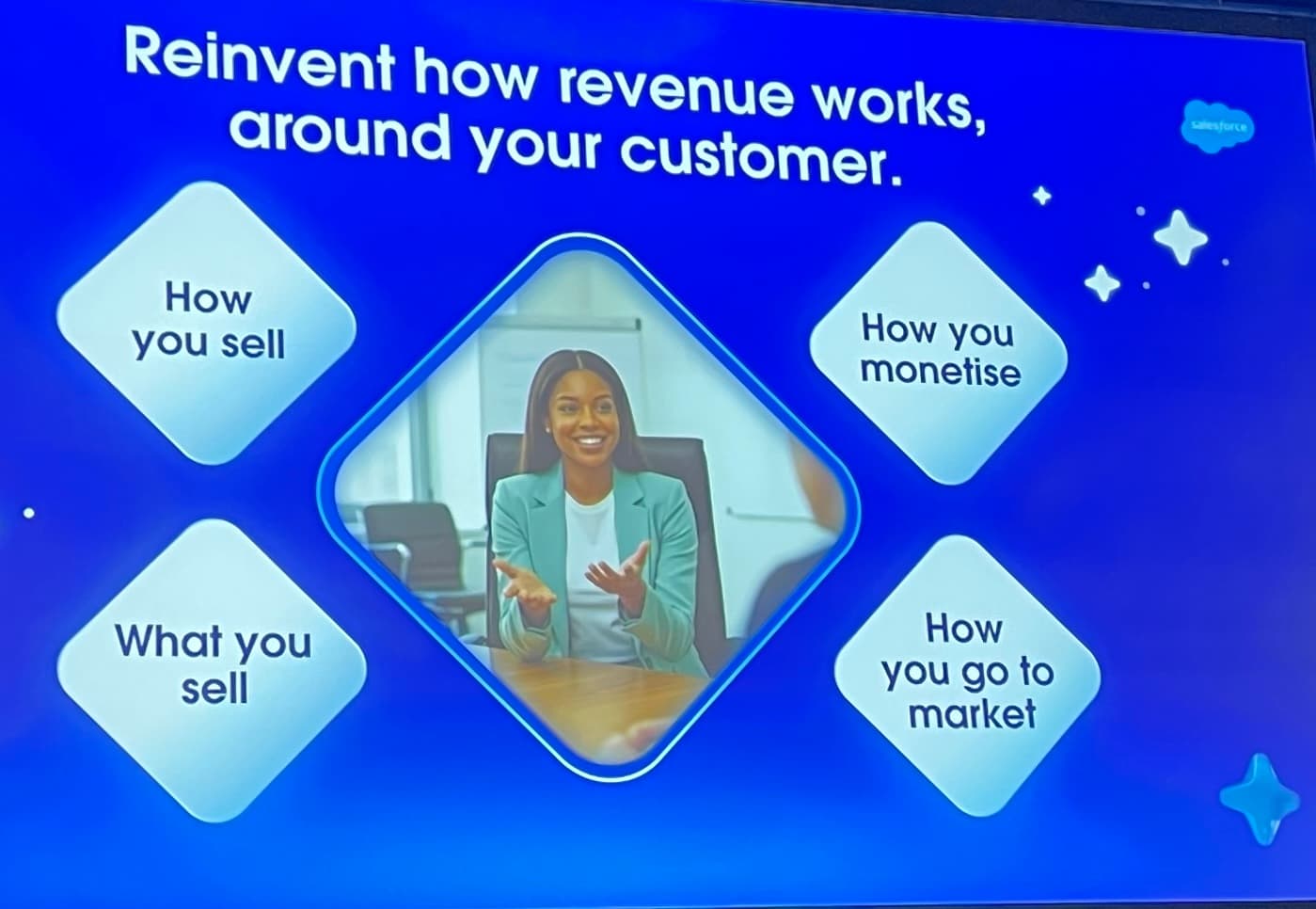
Four key revenue questions
| Question | What it really means | Common example |
|---|---|---|
| What do you sell? | Product, pricing, and catalogue are consistent | Same product has multiple names |
| How do you sell? | Quoting and contracting are standard | Discounts depend on who shouts |
| How do you go to market? | Channels and partners are aligned | Partner quoting differs from direct |
| How do you market? | Journeys match real customer status | Triggers fire at the wrong time |
Here's the key link to agentic tech: If you want agents to take action in revenue processes, you need to make those actions safe and predictable. That means fixing the messy middle first, even if it is just for one journey.
“If your data is messy and your process is unclear, agentic tech does not fix it. It speeds it up.”
Field service: where agentic tech has an obvious ROI
Field service is where you can see value quickly, because the work is real-world and time-bound. You either turn up ready, or you do not.
One Field Service slide said teams are stretched, and called out common blockers like poor integration, limited visibility, no asset connectivity, manual reporting, and non-optimised scheduling. It also showed two big numbers:
- •70% facing a resource shortage
- •56% of mobile workers reporting burnout
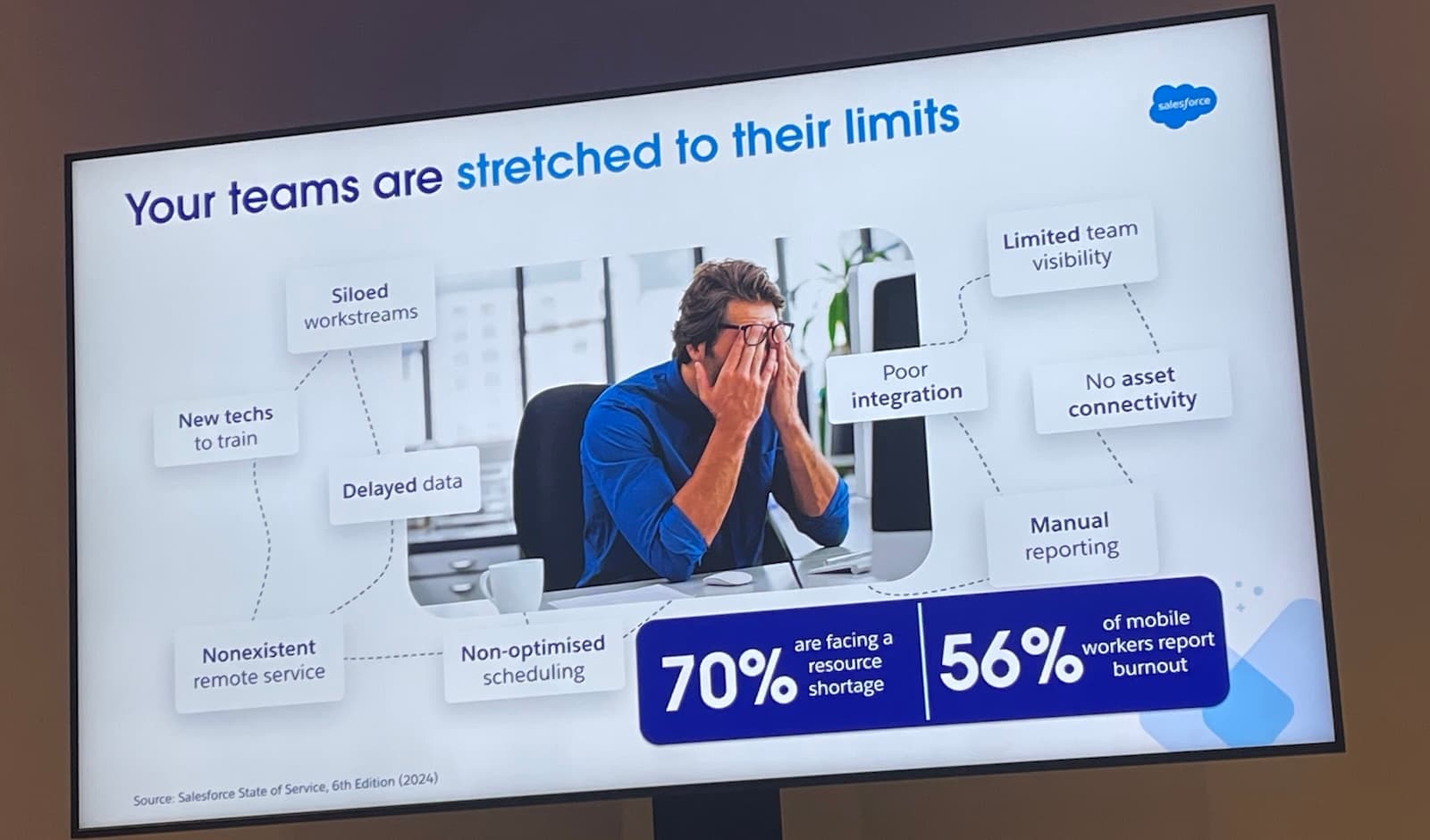
Teams are stretched
This is exactly where "agentic" can help, as long as you keep it controlled.
What "asset-centric service" means
You are not just supporting a customer. You are supporting the thing they own (asset).
So you need to track:
- •what was installed
- •what changed
- •what parts were used
- •what's due next
- •what might fail soon
What the platform view looked like
There was a clear "stack" view: customer experience, work and asset management, scheduling and dispatch, mobile workforce, and operational excellence, with Agentforce sitting across it.
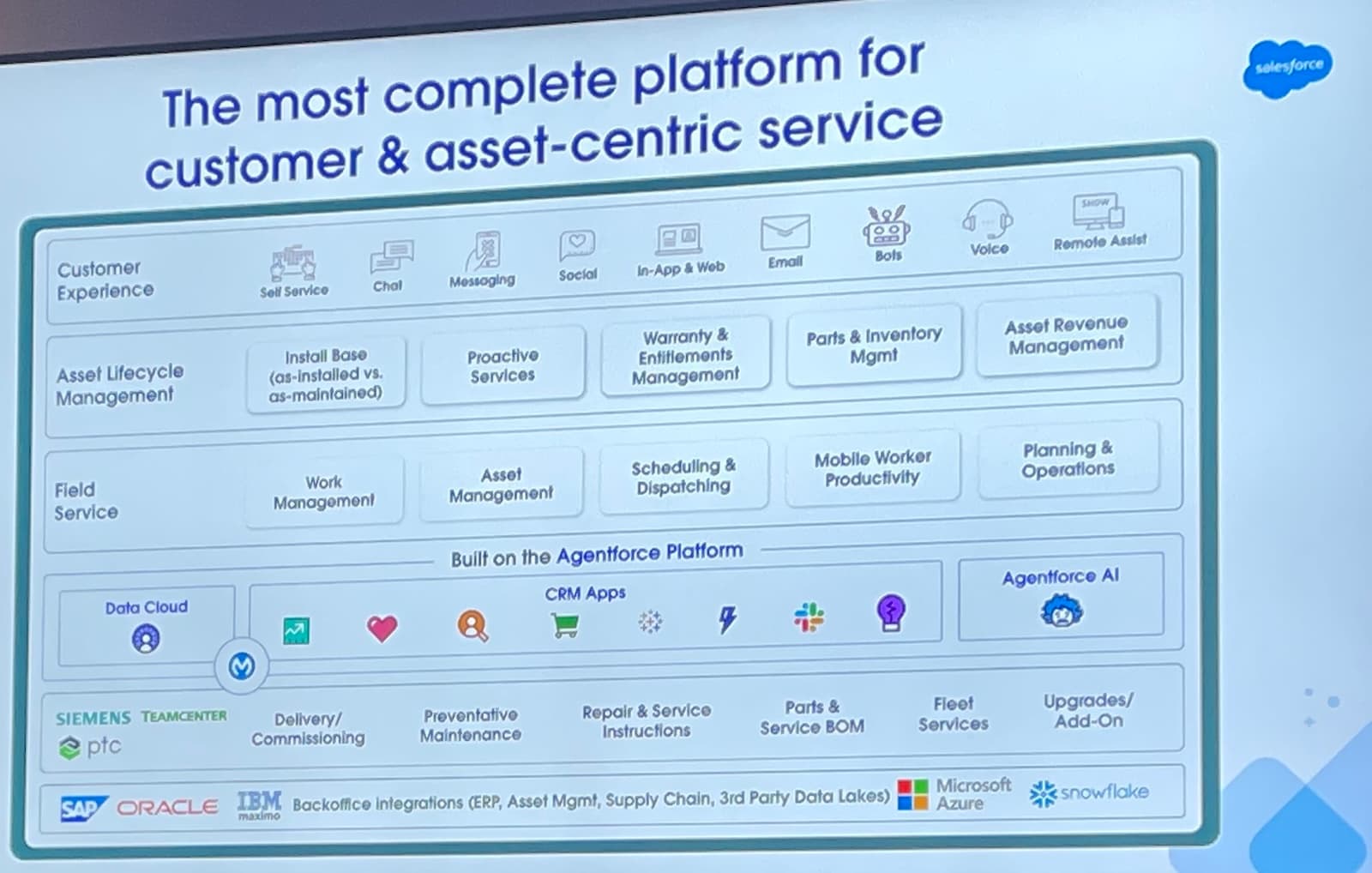
Field service platform stack view
| Capability area | What it covers | Why leaders care |
|---|---|---|
| Customer experience | Self-service, messaging, voice, remote assist | Faster service, fewer avoidable calls |
| Work and asset management | Install base, warranties, parts, proactive service | Fewer repeat visits, better first-time fix |
| Scheduling and dispatch | Right job, right person, right time | Less chaos, better utilisation |
| Mobile workforce | On-site execution, checklists, updates | Better productivity, cleaner data |
| Operational excellence | Reporting, governance, continuous improvement | Scales without heroics |
A real example shown: Agentforce used to cut admin loops
The "Genius Sports: Agentforce in Action" slide was a good example of where value comes from: invoice automation, fewer credit notes, less time wasted on invoice queries, and faster quote creation.
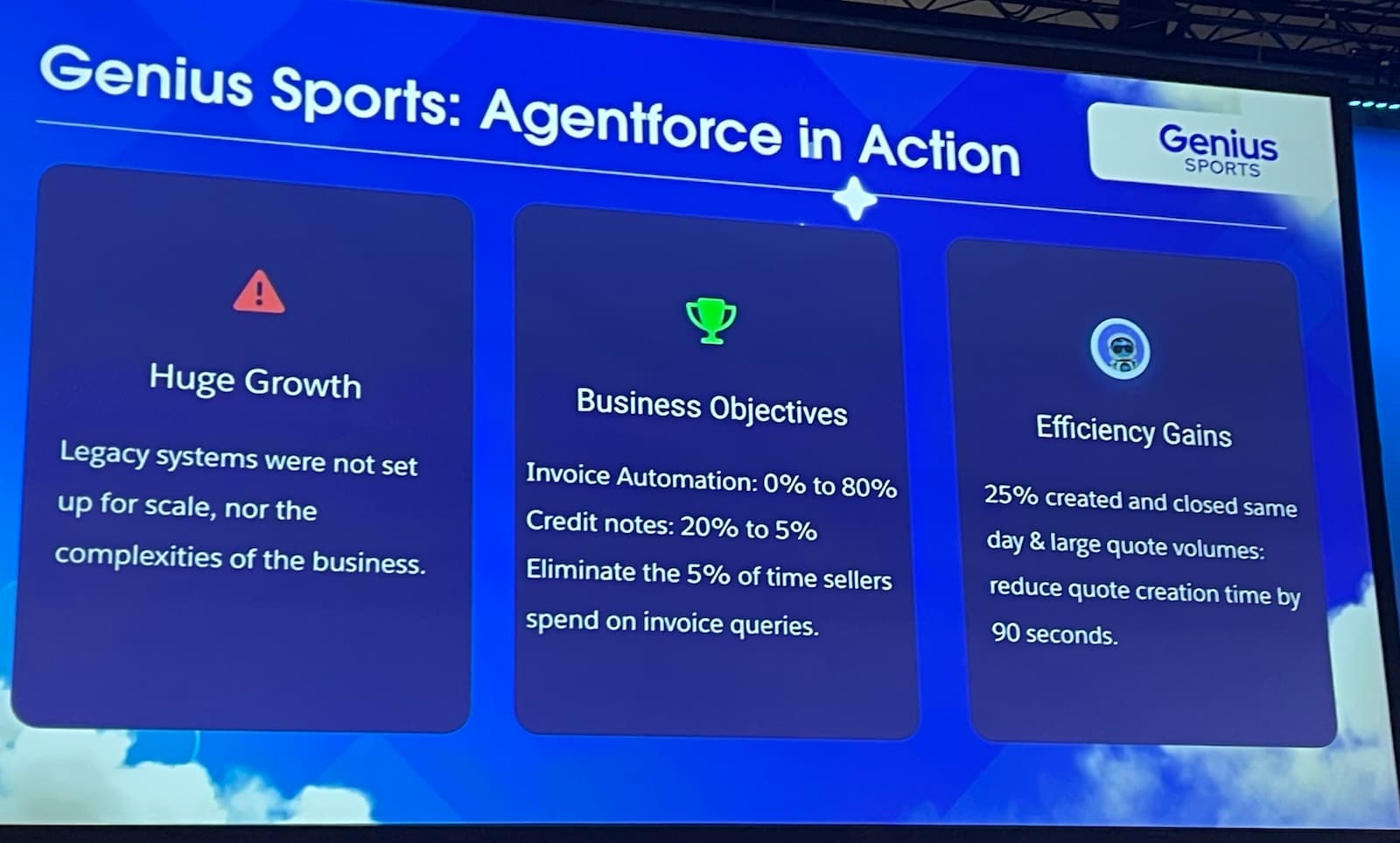
Genius Sports: Agentforce in Action
That's the honest truth here: growth is often blocked by admin loops, not by a lack of strategy.
Marketing Cloud journeys: three patterns you can copy
Marketing Cloud content was practical because it focused on repeatable patterns.
1) New customer journey: get them to value fast
The slide's message was basically: personalise early, use your data (and agents) to make a strong first impression, then guide with a clear next step.
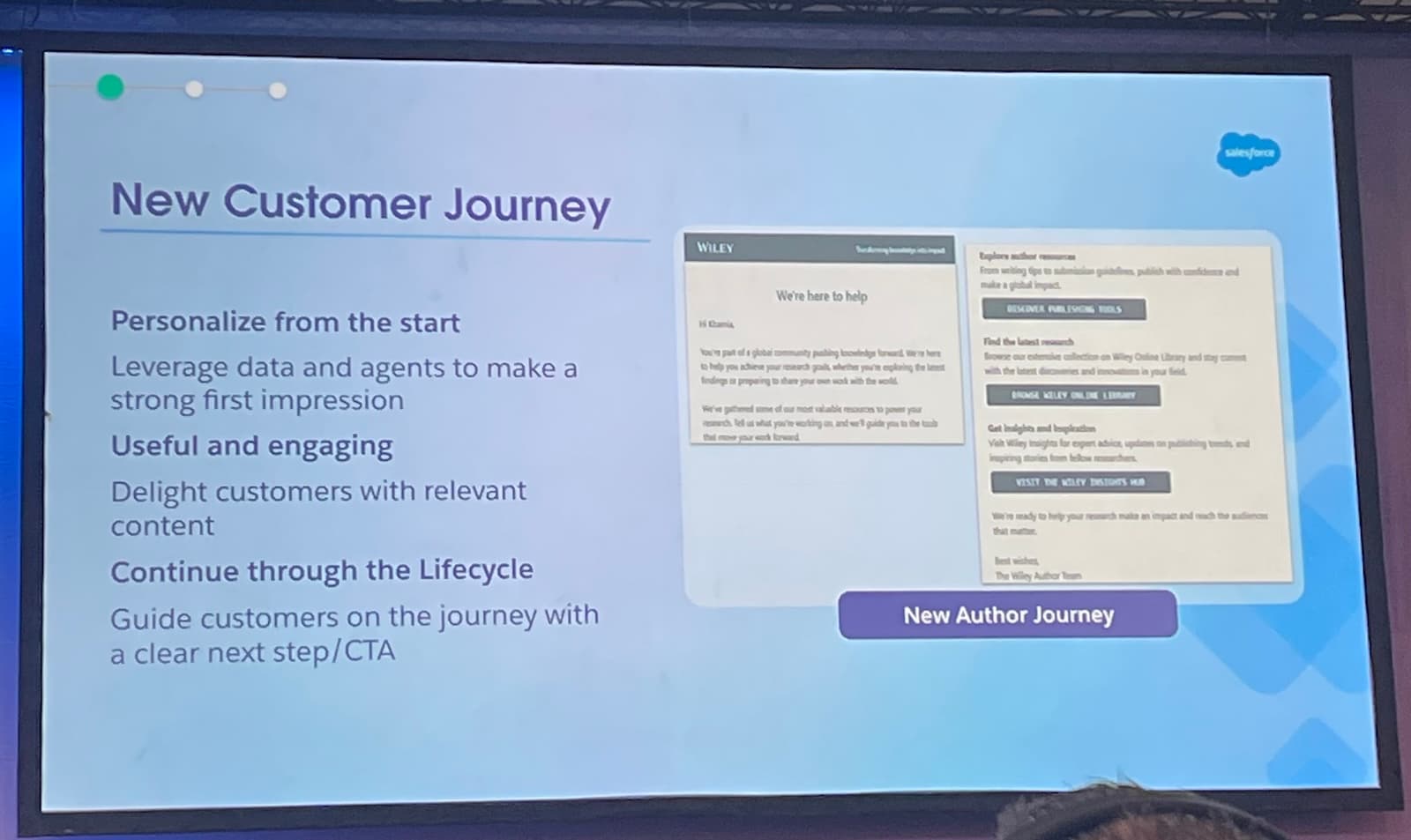
New customer journey
A simple version you can run:
- •Day 0: Welcome plus one next action
- •Day 2: Quick win guide
- •Day 7: Show what good looks like
- •Day 14: Ask one question that improves segmentation
2) Event-triggered journey: act fast and make it relevant
The event-triggered slide had a strong line: show, don't just tell. It also gave an example outcome linked to revenue and recipient volume.
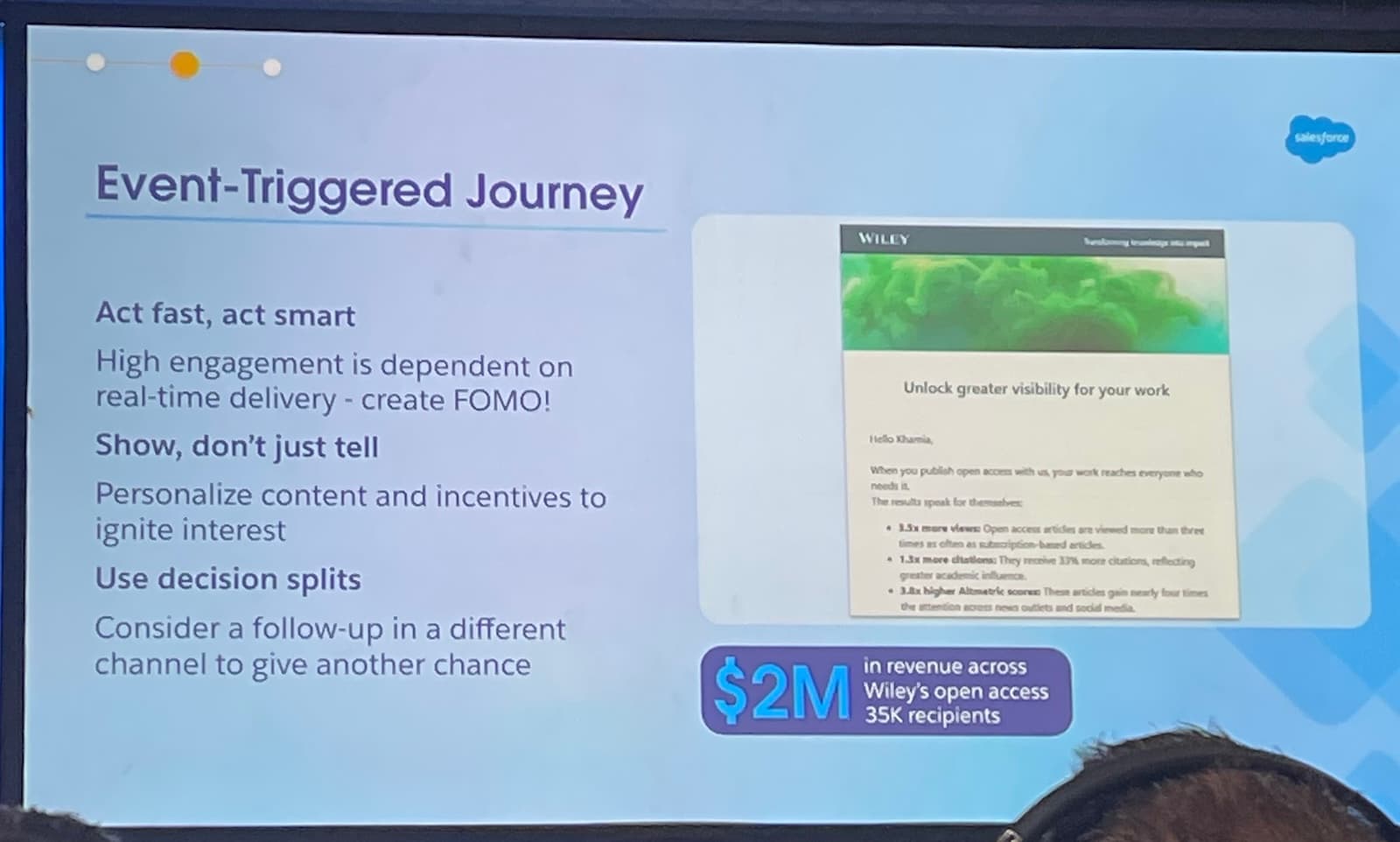
Event-triggered journey
In practice, event triggers should be based on clean signals:
- •quote created but not progressed
- •onboarding step completed (or not)
- •appointment booked, cancelled, or missed
- •renewal window opening
3) Re-engagement journey: be persuasive, then be brave
This slide was honest: you need a reason to return, you should test, and you should not be afraid to suppress disengaged audiences to protect sender reputation.
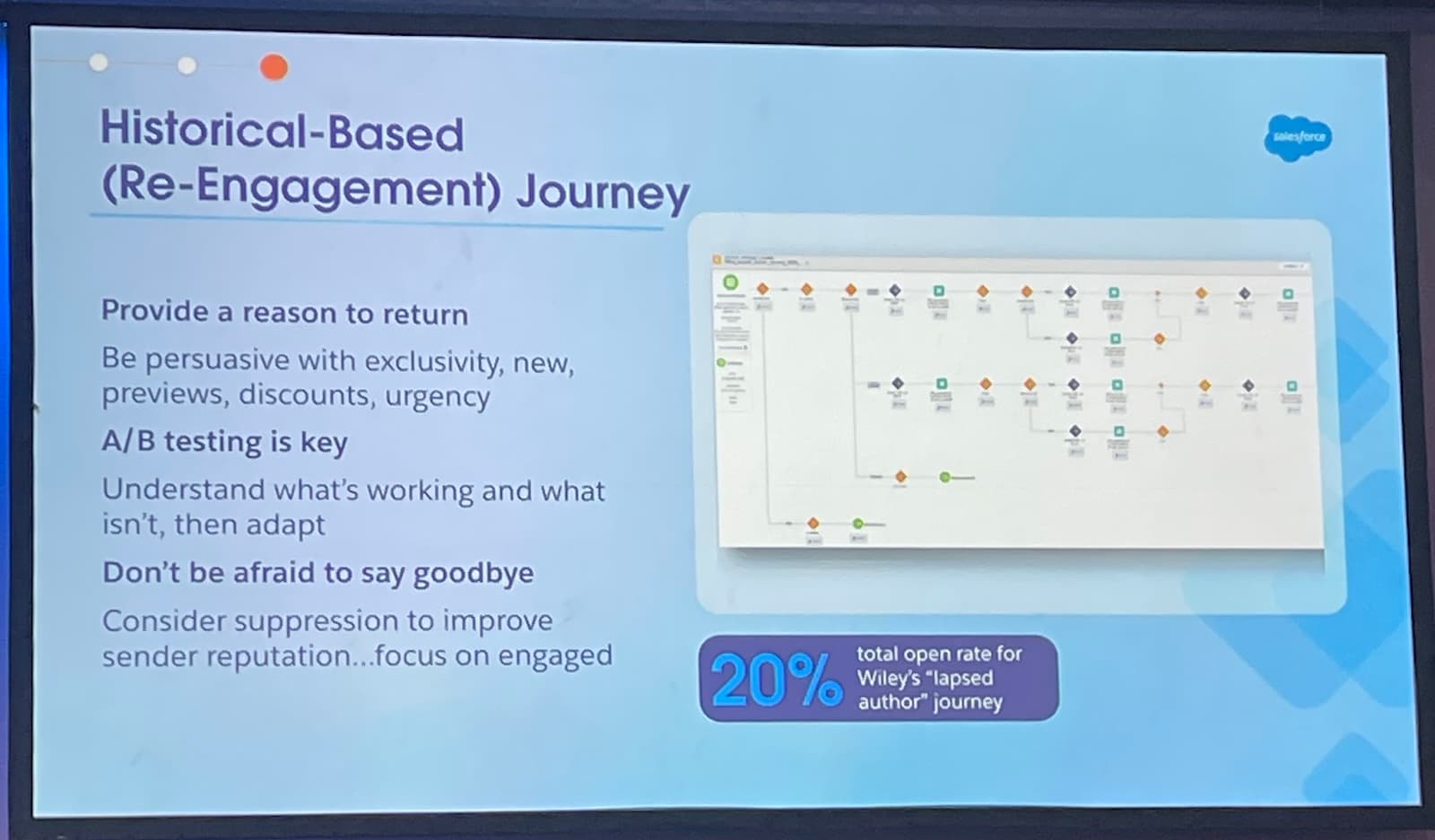
Re-engagement journey
Quick table: which journey do you build first?
| If your problem is… | Build this first | Why |
|---|---|---|
| New users do not activate | New customer journey | Fast feedback loop |
| Leads go quiet after a key action | Event-triggered journey | Relevance is easy to prove |
| List is big but performance is falling | Re-engagement journey | Protects deliverability |
A simple pilot-first delivery plan for Agentforce
This is where most teams go wrong. They try to roll out "AI agents" everywhere, all at once.
A better approach is what your brain already knows is sensible:
Start with one journey, make it safe, measure it, then decide what to do next
This is also exactly how my fixed-price offering is structured:
- •one controlled pilot
- •clear scope
- •guardrails and approval points
- •audit trail
- •measurement pack that tells you whether to scale, adjust, or stop
What a good first Agentforce pilot looks like
From the "best fit" criteria on the offering page, a first pilot works best when the work is:
- •high-volume and repeatable (triage, routing, summaries, booking, FAQs)
- •measurable (you can count time saved, errors reduced, backlog cleared)
- •safe (clear boundaries and human approval where needed)
Pilot deliverables you should demand
If someone proposes an Agentforce pilot without these, be careful.
| Deliverable | Why it matters |
|---|---|
| One production-ready journey | Forces focus and proves it can work in real life |
| Defined actions and guardrails | Stops sprawl and reduces risk |
| Audit trail | You can explain what happened and why |
| Measurement pack | Lets you scale based on evidence |
| Training and handover | Stops value dying after go-live |
If you want to run a controlled Agentforce pilot in six weeks, with one journey done properly, start here:
View Agentforce Pilot OfferingScorecard: what to measure so you know it worked
If you want to be clinical about this (and you should), choose a small set of metrics that show value and risk.
| Area | KPI | What "better" looks like |
|---|---|---|
| Service | Average handle time or time-to-triage | Down, without quality dropping |
| Service | Backlog volume | Down, week on week |
| Service | Re-open rate | Down (fewer wrong routes, fewer bad answers) |
| Field service | Schedule adherence | Up (less chaos) |
| Field service | First-time fix rate | Up (fewer repeat visits) |
| Marketing | Time-to-trigger | Minutes or hours, not days |
| Marketing | Journey conversion | More people take the next step |
| All | Manual admin time | Down, measured in hours saved |
If you can't measure it, it's not a pilot. It's theatre.
Sources
Here are two sources that back the big themes in this article:
- 1.Salesforce Agentforce (what it is, and the "agentic" framing)
- 2.MuleSoft Connectivity Benchmark Report (Salesforce) (the underlying problem of disconnected systems)
Stop talking about agentic tech and actually prove value
If you want to stop talking about agentic tech and actually prove value in a controlled way, with one journey and real measurement, start here:
View Agentforce Pilot OfferingAuthor

You may also like…

Frequently asked questions
What does “agentic enterprise” mean?
It means using software agents that can take action, not just answer questions, as long as you give them good data and clear guardrails. As one slide put it, an agent is software that can do work, not just talk about work. It needs boundaries: if you let it roam, you get risk rather than results.
What is the “messy middle” in revenue operations?
It is the gap of disconnected processes between CRM on one side and ERP on the other, where work leaves the system and becomes human glue. To find yours, pick one revenue stream such as renewals and map where intent starts, where the quote is created and changed, where approvals happen, where a deal turns into an order, where the invoice is created, and where disputes begin. The points where work leaves the system are your messy middle.
Does agentic AI fix messy data and unclear processes?
No. If your data is messy and your process is unclear, agentic tech does not fix it, it speeds it up. Agentic technology does not replace delivery discipline; it increases the need for it. That is why the advice is to fix the messy middle first, even if only for one journey.
How should you start with Agentforce?
Start with one controlled pilot: one journey, made safe with guardrails and approval points, measured, then decide what to do next. A first pilot works best when the work is high-volume and repeatable (triage, routing, summaries, booking, FAQs), measurable (time saved, errors reduced, backlog cleared), and safe (clear boundaries with human approval where needed).
Why is field service a good place to see ROI from agentic tech?
Field service shows value quickly because the work is real-world and time-bound: you either turn up ready or you do not. The sessions highlighted teams under strain, with 70% facing a resource shortage and 56% of mobile workers reporting burnout. The Genius Sports example showed value from invoice automation, fewer credit notes, less time wasted on invoice queries, and faster quote creation, because growth is often blocked by admin loops rather than a lack of strategy.
Which Marketing Cloud journey should you build first?
It depends on your problem. If new users do not activate, build a new customer journey for a fast feedback loop. If leads go quiet after a key action, build an event-triggered journey where relevance is easy to prove. If your list is big but performance is falling, build a re-engagement journey to protect deliverability.