Salesforce
TDX 2026: The 5 Announcements That Will Change How You Deliver Salesforce
I spent two days at TDX San Francisco in April 2026. Ten sessions. Three hundred slides. One very tired notebook.
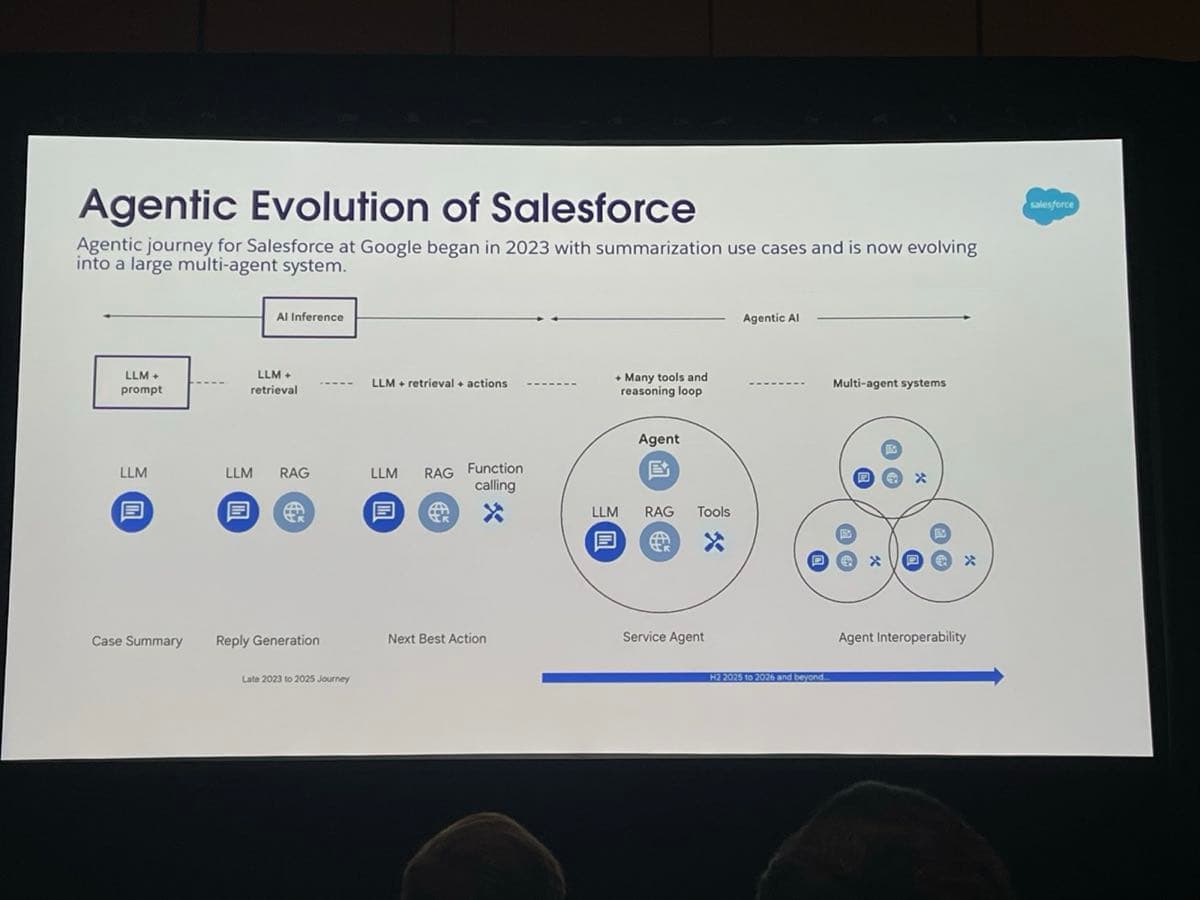
The line that stuck with me came from the main keynote: “The way we build software 18 months ago is different than 12 months ago, is different than six months ago, is different than yesterday.” That is the pace. And the announcements at TDX matched it.
If you deliver Salesforce programmes, five announcements stand out. Not because they are shiny. Because they change the day-to-day of how you design, build, test, and run Salesforce work. Here they are in plain English, with what they mean for your next programme.
| Announcement | What it does | Who should care |
|---|---|---|
| Headless 360 | Salesforce becomes a composable, open platform with REST APIs, MCP endpoints and CLI commands everywhere | CIOs, architects, anyone stitching Salesforce to other systems |
| Agent Script | A flat, versionable file that defines agent behaviour with variables, conditional logic and before/after steps | Developers, architects, anyone scared of non-deterministic agents |
| $50M Agent Exchange fund | Up to 20 investments for partners building and monetising agents, skills and components | ISVs, partners, founders looking for a new route to market |
| Experience Layer | Define a UI once, render it natively on Slack, Teams, Mobile, ChatGPT, Claude, Gemini, web | Product leaders, digital teams, anyone tired of building the same thing five times |
| Data 360 as the foundation | Unified data tier powering Agentforce, Tableau Next, Marketing Cloud and Agentic Enterprise Search | Data leaders, anyone whose agent accuracy is stuck |
1. Headless 360: Salesforce is now open and composable
Salesforce Customer 360 has been a walled garden for years. Powerful inside, awkward at the edges. Headless 360 changes that. Every layer of the platform now exposes REST APIs, MCP endpoints, and CLI commands you can call from anywhere.
In practice, you can now build React apps on top of Salesforce. You can let ChatGPT, Claude or Gemini call into Salesforce via MCP. You can deploy Salesforce-grounded agents on Slack, Teams, mobile, and your own website. You are no longer stuck inside Lightning.
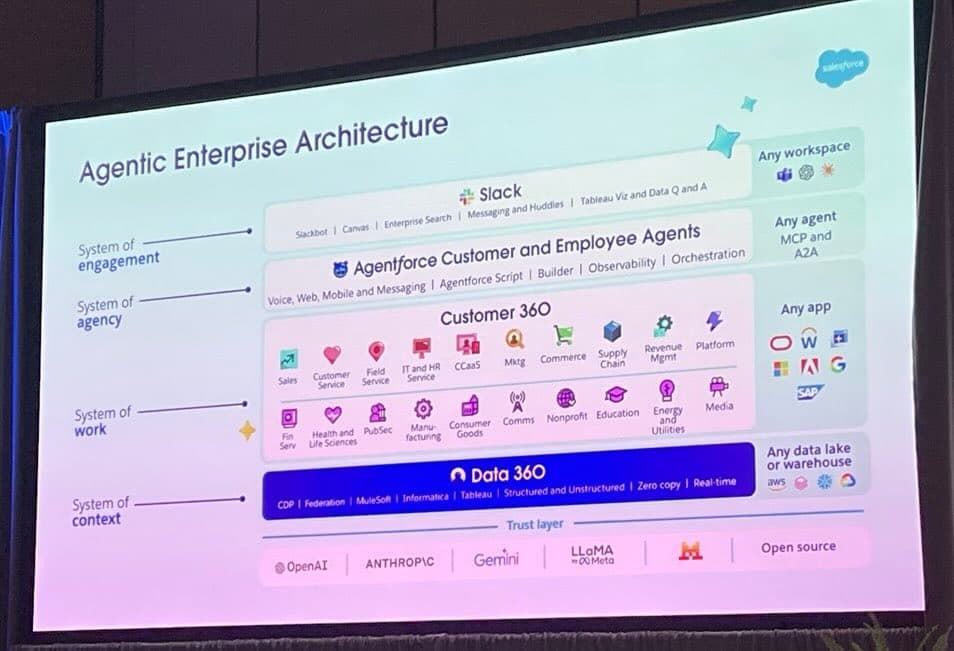
Headless 360 is powered by the Salesforce Agentic Enterprise Architecture: a four-layer model of engagement, agency, work, and context.
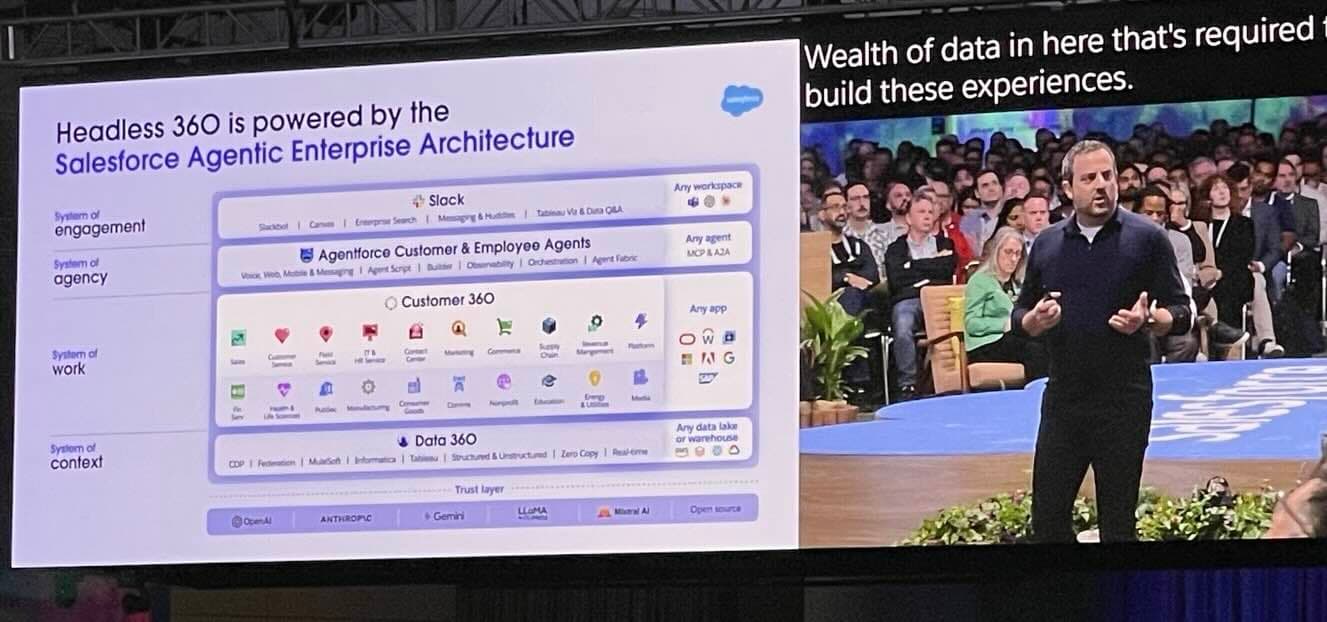
Headless 360: one platform, anywhere humans and agents work
What it means for your delivery team
Three things change straight away.
- •Integration patterns are going to multiply. It is not just APIs anymore. You will be making architectural decisions between direct APIs, MCP servers, MCP bridges via MuleSoft, and Agent2Agent (A2A). Each has different trade-offs on determinism, security and cost.
- •Your UI strategy gets simpler, not harder. Instead of building a Lightning app, a Slack app, and a mobile app, you define the experience once and let Salesforce render it everywhere. More on that later.
- •“Salesforce developer” means something broader now. If your team only knows Apex and Lightning, they are going to feel the gap fast.
2. Agent Script: determinism comes to agents
Here is the problem every CIO has with agents. You type the same prompt twice and you get two different answers. That is fine for a chat app. It is a non-starter for enterprise work.
Agent Script is Salesforce’s answer. It is a flat, versionable file that defines what an agent does, with variables, conditional logic, before-and-after steps, and connections to sub-agents. You can check it into GitHub. You can deploy it like any other piece of code. You can test it. You can roll it back.
The old terminology was topics. Topics are now sub-agents. And sub-agents have something topics never had: the ability to run before-and-after logic, hold variables, and control flow deterministically.
Deterministic vs probabilistic: the table your CIO needs
| Traditional software | Generative AI | Scripted agents |
|---|---|---|
| Same input, same output every time | Same input, different output every time | Same input, same output (when you want it) |
| 1+1 = 2 | 1+1 = 2, or 2.1, or "two" | 1+1 = 2 because you scripted it that way |
| Easy to test | Hard to test at scale | Testable with assertions and evaluators |
| Easy to audit | Hard to explain | Explainable because the logic lives in the script |
One of the instructors at TDX put it best: “If I’m a C-level executive, I want something that I am going to get the same response back every time. I want reliability.” Agent Script is how you give them that.
Three ways to build an agent now
- •AI-assisted: natural language, fastest to get started, least control
- •Canvas: visual builder, good for refinement
- •Script: the flat file, full control, production-grade
If you are serious about agents in production, your team needs to live in Script view. The other two are for prototyping.
3. The $50M Agent Exchange fund: a new partner economy
AppExchange changed the Salesforce partner world. Agent Exchange is its successor. It is a marketplace for agents, skills and MCP servers. And Salesforce has put $50 million behind it: up to 20 investments for new partners building on the platform.
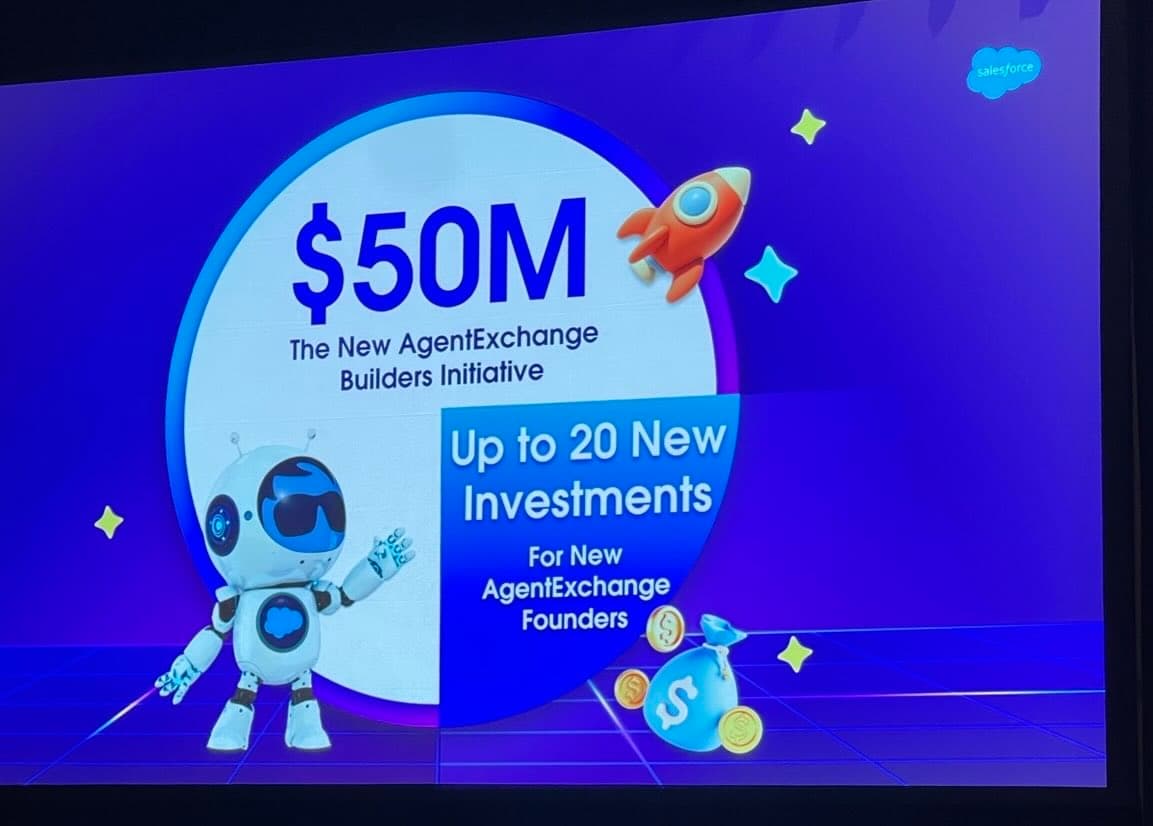
The $50M Agent Exchange Builders Initiative: up to 20 investments for new founders
Why this matters
If you are an ISV, a consultancy, or a founder sitting on a good agent idea, this is a real route to market. The monetisation plumbing is being built for you.
If you are an enterprise buyer, the calculation shifts. You used to build custom agents because nobody else had them. In 12 months, you will be buying most of the common ones off the shelf. Your own team’s build effort should go into the 10% that actually differentiates you.
If your Agentforce roadmap is full of agents that do generic work, check the Exchange before you build. Someone else is probably already doing it.
“The way we build software 18 months ago is different than 12 months ago, is different than six months ago, is different than yesterday.”
4. The Experience Layer: build once, render everywhere
This one might be the most practical of the lot. The Agentforce Experience Layer lets you define a UI once, using a standard schema, and render it natively on any surface: Slack, Teams, Mobile SDK, ChatGPT, Claude, Gemini, your website.
Remember when we had to test everything in ten browsers? Or when mobile meant building a separate app from scratch? This is the same problem. And Salesforce is solving it the same way: abstract the surface, keep the logic.
Salesforce is claiming 5x to 10x productivity gains. Even at half that, it changes what is reasonable to scope in a programme.
What changes for delivery teams
Programme scoping gets simpler. Instead of “build for web plus Slack plus mobile” as three parallel streams, you scope one experience and one deployment pattern. Cross-platform bugs become someone else’s problem.
Design reviews get more important, not less. If one schema renders on seven surfaces, getting the schema right is where the quality lives. That is an architect problem, not a front-end problem.
5. Data 360 as the foundation of everything
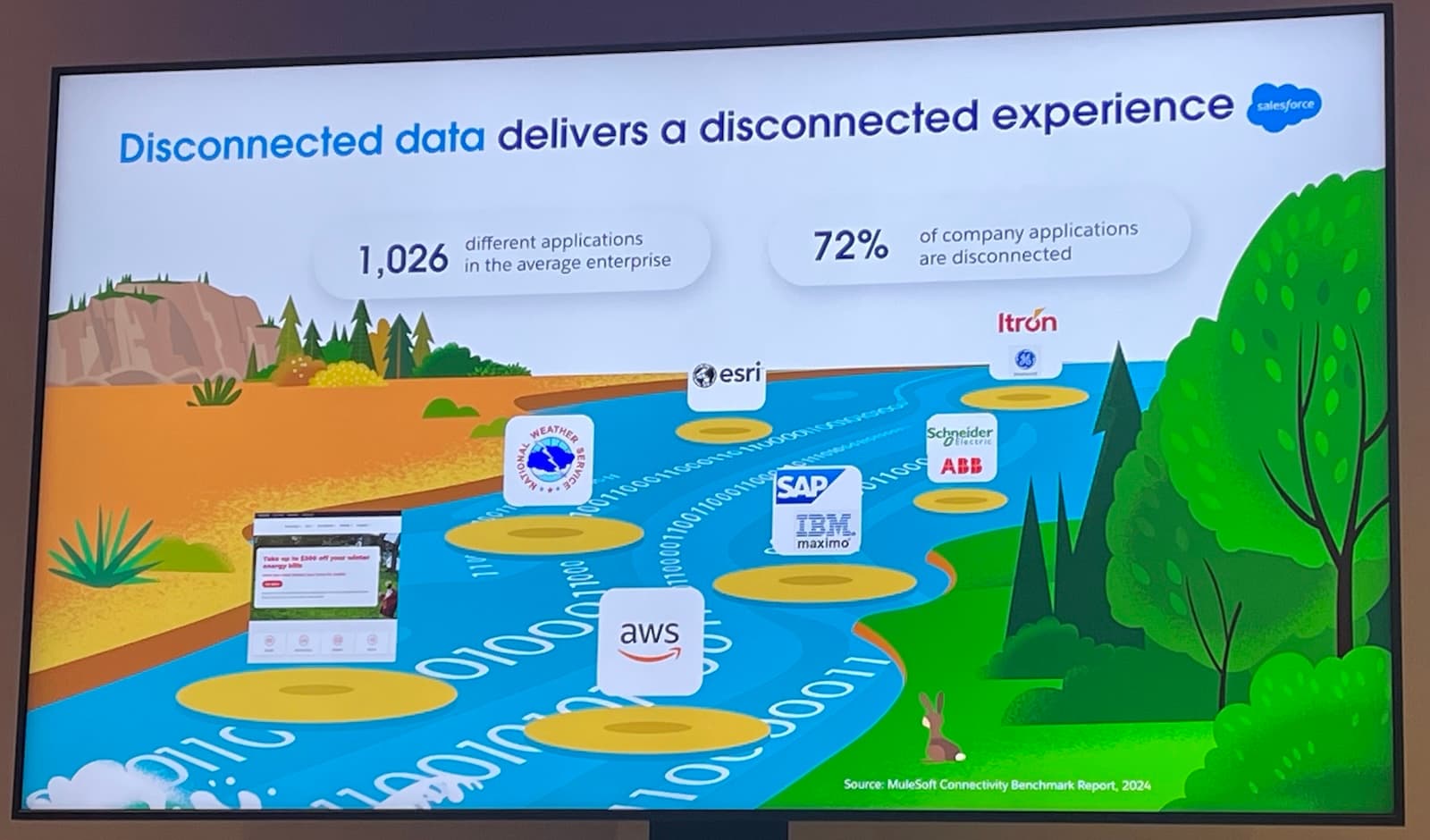
Data Cloud has been rebranded to Data 360. Fine. That is not the announcement. The announcement is what it now does.
Data 360 is now the foundational data tier for Agentforce, Tableau Next, Marketing Cloud, and a new product called Agentic Enterprise Search. It is where Salesforce logs every agent conversation for observability. It is where unstructured data gets chunked, vectorised, and searched. It is the grounding layer that makes agents accurate rather than hallucinatory.
The three things I was not expecting
- •Zero Copy is now the default pattern. You do not need to move data out of Snowflake, Databricks or BigQuery. You reference it at runtime via query federation, file federation, or caching. Three patterns with different cost and latency trade-offs.
- •All ingestion is now free. Under the new profile-based pricing model, even real-time and accelerated ingestion comes in at zero cost. You pay for unstructured processing and some data processing. Not for bringing data in.
- •Agentic Enterprise Search is coming. It is essentially an out-of-the-box search agent that lives natively inside Salesforce and replaces global search. Search your unified data, structured and unstructured, in natural language. Replaces a lot of custom search builds.
A word of warning from the partner keynote
Data 360 is not an MDM. Do not try to make it one. The speaker was explicit: “Data Cloud is not trying to be an MDM solution. It’s not.” If you already have Reltio or Informatica, Data 360 should receive clean data from them, not replace them.
What it all means for your next Salesforce programme
I have been to a lot of these conferences. TDX 2026 felt different. The announcements fit together. Headless 360 exposes the platform. Agent Script makes agents reliable. Agent Exchange creates the marketplace. Experience Layer solves distribution. Data 360 makes the whole thing accurate.
If you are scoping a Salesforce programme right now, here is what I would do differently on the back of this.
- •Stop designing UI for specific surfaces. Design the experience once. Let the Experience Layer handle the rest.
- •Check Agent Exchange before you build. Every agent you do not build is six months you can spend on something that actually differentiates.
- •Invest in Agent Script skills in your team. Not Canvas. Script. It is where production work lives.
- •Treat Data 360 as the grounding tier, not a CRM add-on. Your agents are only as accurate as the data they can reach.
- •Get your integration architect in the room early. Four integration patterns now, not one. The wrong choice costs.
55% of enterprise companies say their biggest problem is not having enough AI talent. That was the keynote stat. The gap is not shrinking. But the tools are getting sharper, and the pattern is clearer. If you build with architecture in mind, you are already ahead.
Want help turning TDX announcements into a working pilot?
If you want to take any of this and turn it into a controlled pilot in your org, with architecture, measurement and guardrails, let’s talk.
Get in touchAuthor

You may also like…