Salesforce
AIforce World Tour London 2026: The Tech Is Ready. Most Organisations Aren't.
Notes from ExCeL on 15 October 2026, for the people who have to make AI pay: marketing, sales, operations, technology and programme leaders.
The day in 76 seconds, filmed on my phone at ExCeL. Every point is on screen, so it works with the sound off.
Read the film's on-screen text
- The tech is ready. Most organisations aren't.
- AIforce World Tour London. ExCeL London, Thursday 15 October 2026.
- Three lessons from the day. Anna Bromley, Agile Delivery.
- Lesson 1 of 3, people. Adoption is behaviour change. Stop treating AI adoption like a system implementation. Start treating it like a capability and behaviour change programme. (Immersive, Theatre 4)
- AI value is won or lost at the handoff. A gauge runs from avoiders to collaborators, experimenters and delegators, then snaps back. Your least mature team member sets the pace.
- Lesson 2 of 3, data. Data before agents. Retail, memberships and ticketing, visitor attractions, engagement history, and POS and stadium data feed one trusted fan profile, which feeds SpursPlay, web, consent, stadium events and the club and stadium app. Tottenham Hotspur built one trusted fan profile first.
- Lesson 3 of 3, buyers. Buyers decide early. 68% of B2B buyers already have a front-runner when they start. 80% of the time, that front-runner wins. (Forrester, Buyers' Journey Survey 2025)
- So, on Monday: pick one workflow. Fix the data under it. Train the people around it.
- The full write-up, with a plan for every role: agileprojectdelivery.co.uk/insights. Make transformation deliver.
The wall I took my selfie against said AIforce World Tour.
A few days earlier, Marc Benioff had posted on X: "AIForce is officially SIForce." The wall hadn't caught up. To be fair, I wouldn't have reprinted it either.
It's a small thing, but it summed up the day for me. The technology moves faster than anyone can print a banner. The organisations buying it move at the speed of people, and people need longer than a few days.
I spent Thursday 15 October at Salesforce's AIforce World Tour London at ExCeL. Between the keynote and the theatres, I sat in on sessions about the human side of AI adoption, CRM adoption from Salesforce's own customer success team, Tottenham Hotspur's fan data, and how agentic AI is changing B2B marketing.
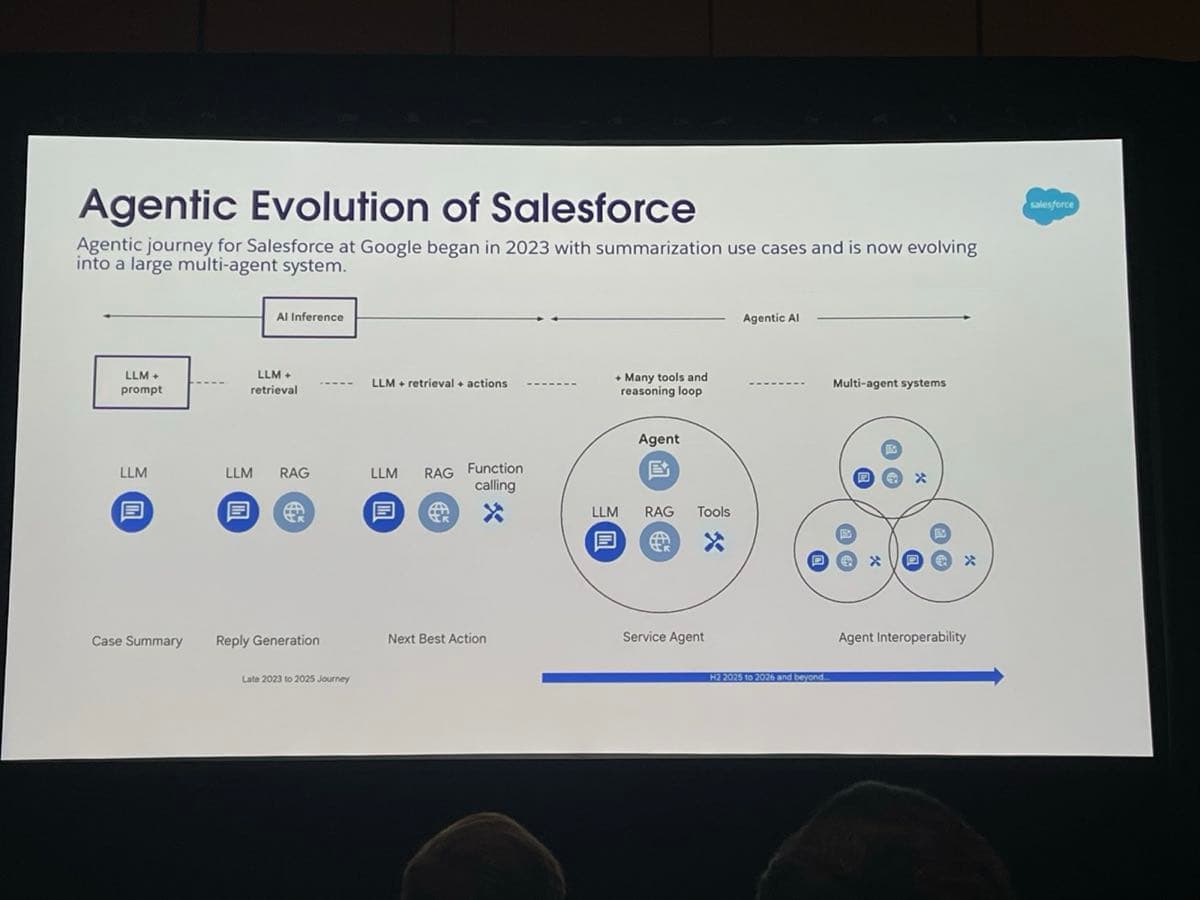
The product slides were slick: agents that qualify buyers, answer questions from your own knowledge base and hand over to a salesperson with the whole conversation attached. I came away fairly sure the technology isn't what's holding most organisations back.
The sessions worth your time were about everything around the technology. People, data and buyers.
The short version
AIforce World Tour London was Salesforce's one-day event at ExCeL London on Thursday 15 October 2026. The sessions I found most useful made four points. AI adoption is a behaviour change programme and needs planning like one. Your least mature team member sets the pace. Agents need one trusted view of the customer before they're any use. And B2B buyers now pick a front-runner before they speak to you.
1. Stop treating AI adoption like a system implementation
The session I'd send every COO to was in Theatre 4. Marcelle Braithwaite, Chief Revenue Officer, and Amy Carlton, Head of Advisory, from the UK Salesforce partner Immersive called it "Beyond the Use Case: The Human Side of AI Adoption". Their opening line has stuck with me.
"A use case tells you what AI can do. It never tells you who has to change."
They put BCG's 10-20-70 rule on screen. BCG's advice is that 10% of the effort on AI should go into the algorithms, 20% into the technology and data, and the other 70% into changing people, the organisation and its processes.
Now look at your own AI budget. If most of it is licences and build, with a training day bolted on at the end, it's weighted the wrong way round.
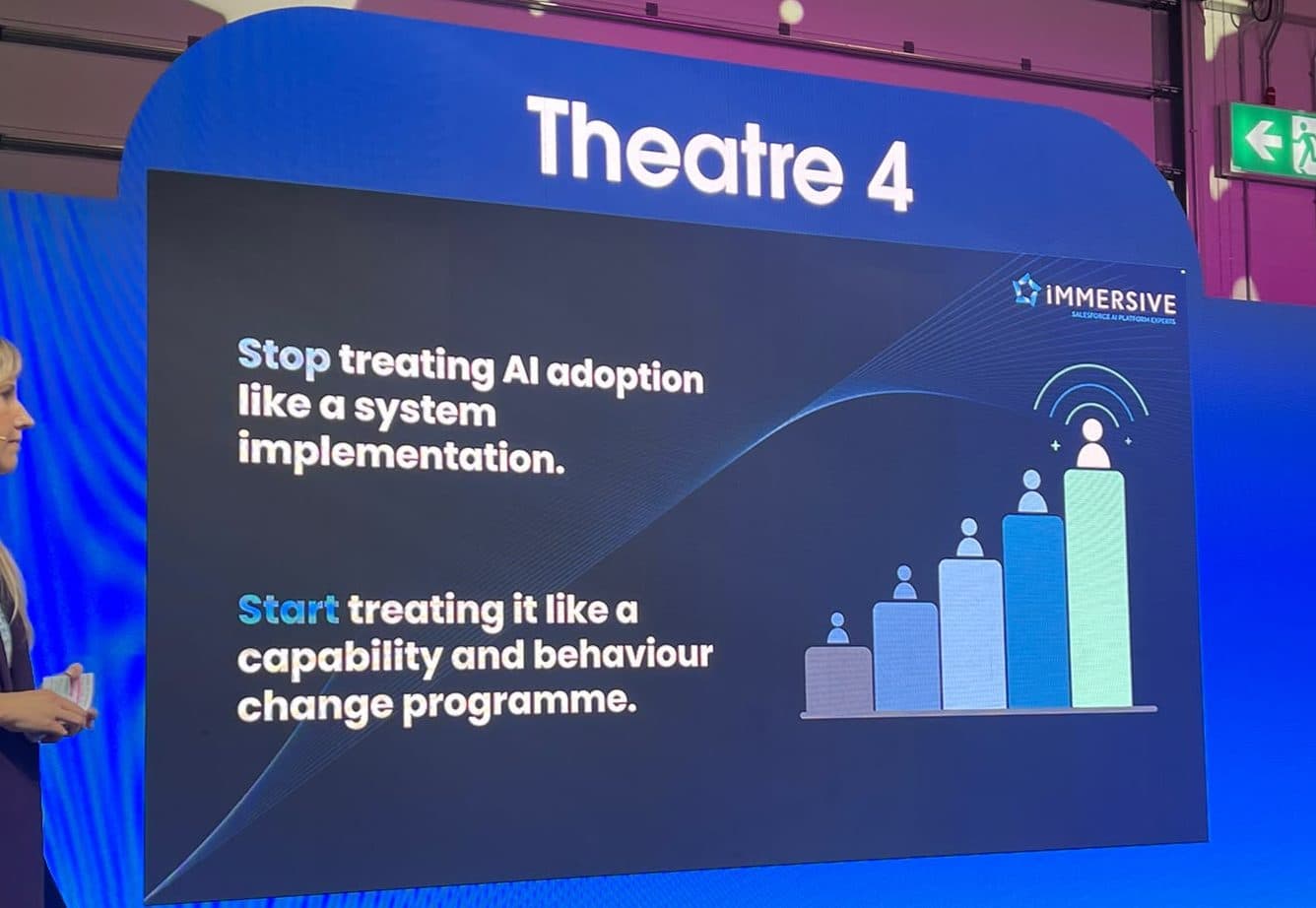
Immersive in Theatre 4. The second half of the slide is the part most plans skip.
Same room, different AI maturity
Their next slide split any team into four groups: avoiders, collaborators, experimenters and delegators. All four sit in the same meeting, get the same licence and the same training, and come out of it in very different places.
The slide only named them, so the descriptions below are my reading, with what I'd give each group.
| Group | What it looks like | What helps |
|---|---|---|
| Avoiders | Haven't really tried it. Some think it's cheating, some think it isn't for their job. | Permission and safety. Clear rules on what's allowed, and a manager who uses AI in the open. |
| Collaborators | Use it as a sounding board. Draft with it, then rewrite most of it. | Examples from their own work, and templates that fit how the team already writes. |
| Experimenters | Try everything. Build their own prompts and shortcuts. | Somewhere to share what works, and guardrails so the experiments stay safe. |
| Delegators | Hand whole tasks to AI and review what comes back. | Review standards, so quality holds as the volume goes up. |
Value is won or lost at the handoff
Then came the line I'd put on the wall of every AI programme office.
"AI value is won or lost at the handoff. Your least mature team member sets the pace."
Here's what that looks like in practice. An experimenter drafts a bid response with AI in 20 minutes. It goes to a reviewer who doesn't trust it, so they rewrite it from scratch over two days. On paper the organisation uses AI. In practice it saved nothing, and the experimenter has learned not to bother next time.
That's value leakage, and it happens at every handoff: analyst to manager, marketing to sales, agent to person. Adoption moves at the speed of the slowest person in the chain. So stop counting licences. Count how much AI-started work gets accepted further down the line.
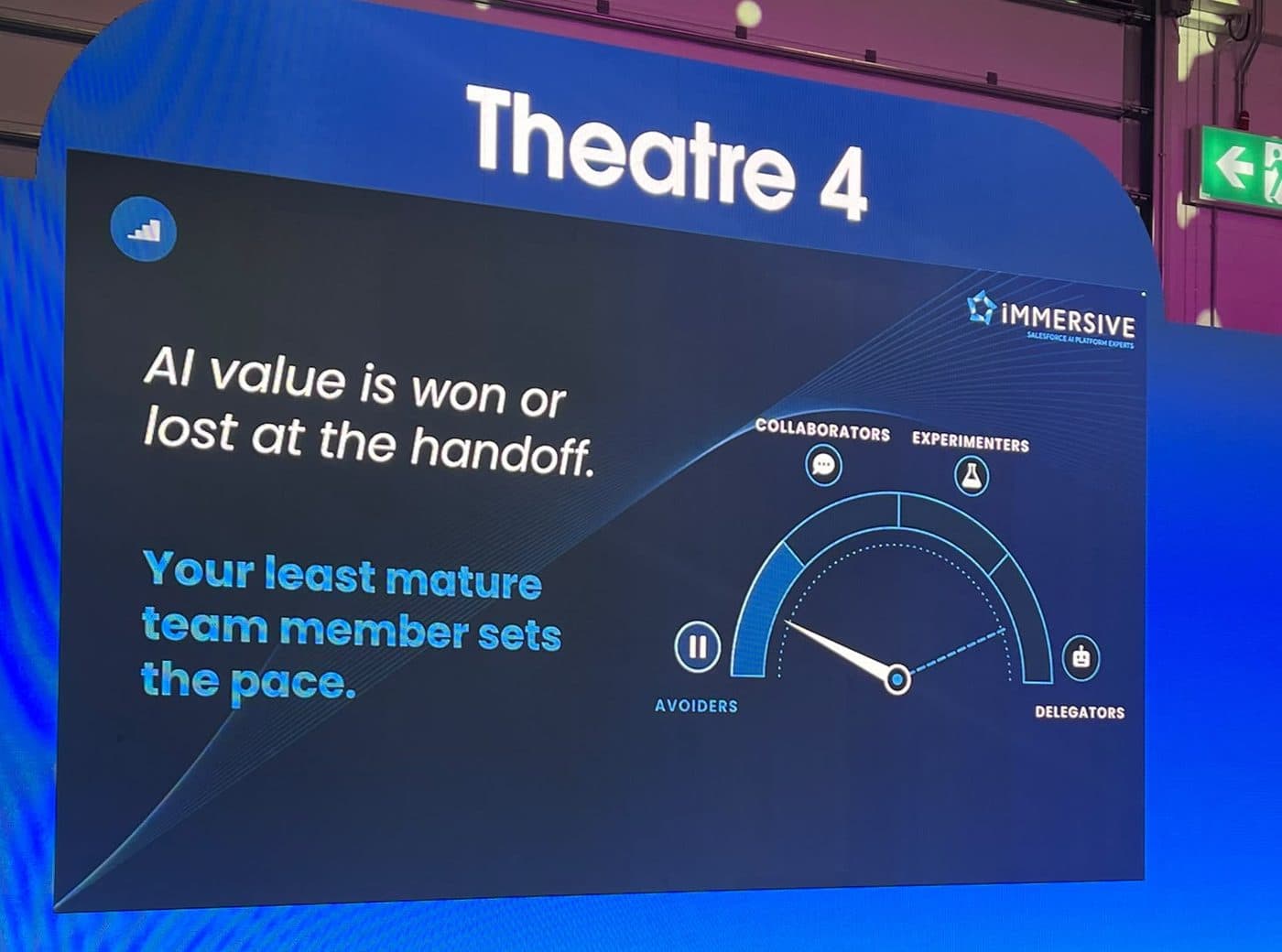
The maturity gauge, from avoiders to delegators.
The stigma is real
Nearly half (48%) of desk workers would be uncomfortable admitting to their manager that they'd used AI for common tasks. That's from Slack's Workforce Index, a survey of more than 17,000 desk workers in 15 countries, the UK included. The top reasons were that it feels like cheating, and the fear of looking less competent, or lazy.
Immersive's answer was my favourite slide of the day.
"The best AI adoption is not quiet. It sounds like 'here's how I did it'."
If people hide their AI use, nobody learns from it, and your experimenters never teach your avoiders. The fix is cheap. Leaders show their own working in team meetings. Templates get a line for "AI-assisted, checked by". A good prompt gets passed round the way a good spreadsheet used to be.
Four gaps, and the skill nobody's training for
They summed it up as four gaps between an AI mandate and real adoption: AI maturity, AI stigma, soft skills and the org model.
Then they split the skills worth investing in. The technical side, prompts and use cases, is what most AI training covers. The other side was judgement and taste: evaluating whether the output is right, and asking "is it me?" Does this sound like us, and would I put my name to it?
That second skill is the one I don't see anyone training for. It's also the one that decides whether AI output survives the handoff.
For COOs and programme directors
If your AI rollout plan has a go-live date and a training session, it's a system implementation plan. A behaviour change plan also has a sponsor who uses the tool in public, a network of experimenters who coach their teams, a baseline of where people are today, measures of what people now do differently, and reinforcement for months after go-live, when the novelty wears off.
2. Salesforce's customer success team said the same thing about CRM
In Theatre 2, Aishwarya Padmanabhan, Customer Success Manager, and Mel Bickford, Customer Outcome Director, ran a session on faster CRM adoption. Their six guiding principles:
- Build an adoption committee
- Know your end users
- Lead with data
- Commit to simplicity
- Plan for change management
- Train, learn, repeat
They had a practical way into number two. Interview users about their needs and priorities. Observe how different people actually work, across locations and devices. Co-design the fixes with them. Then meet a group of power users regularly to hear what's working and what isn't.
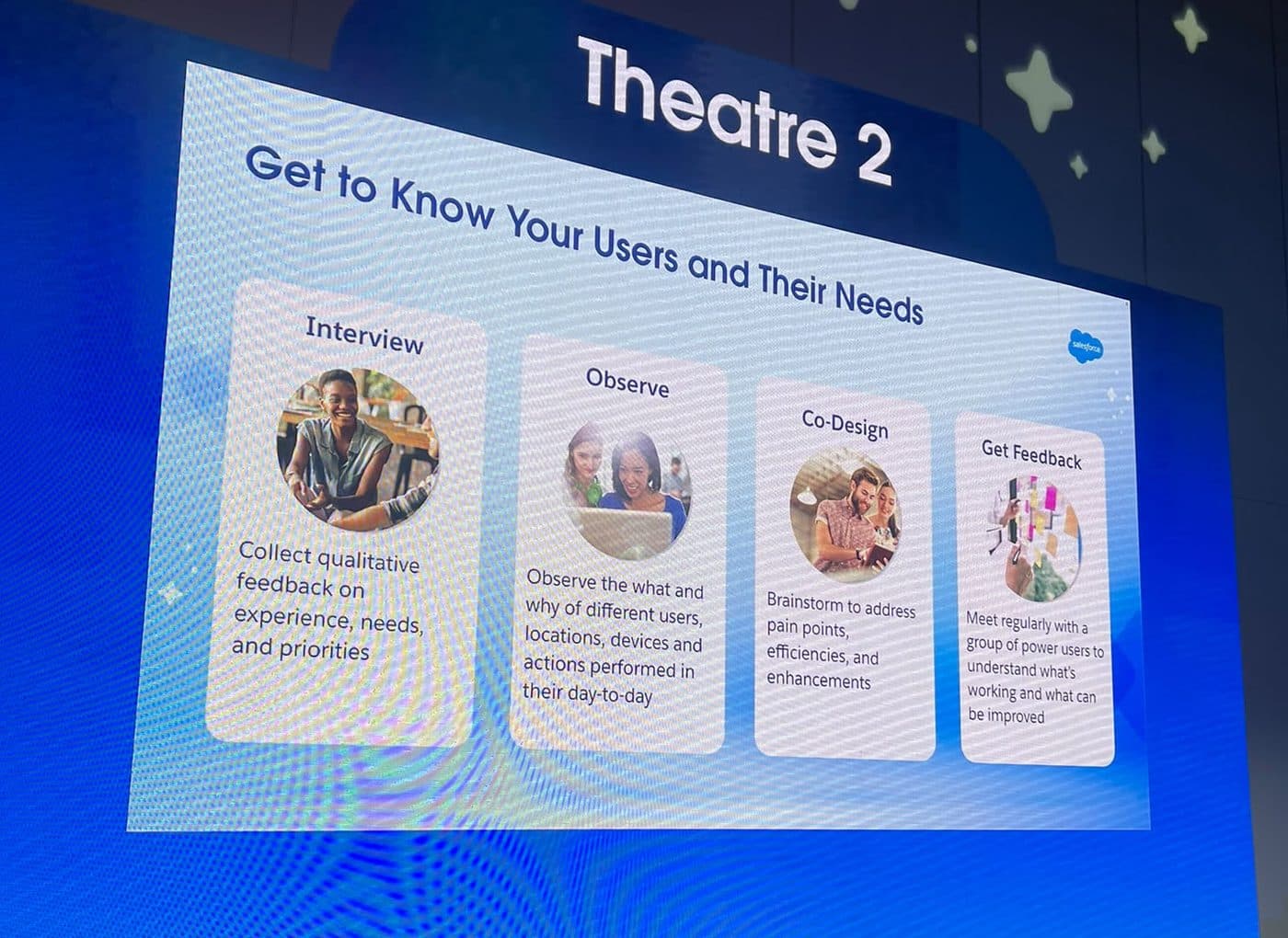
Salesforce's customer success team on getting to know your users.
None of this is new. That's exactly why it matters.
In my experience, the organisations struggling to get value from AI are often the ones that never finished adopting their CRM. The discipline is the same, and you can borrow it directly.
| CRM adoption principle | What it means for an AI rollout |
|---|---|
| Build an adoption committee | Give every AI workflow a business owner, with IT in support, and a monthly forum where owners report usage and results. |
| Know your end users | Watch the job before you automate it. Interview and observe the people doing it today. |
| Lead with data | Measure accepted outputs and time saved for each workflow, and publish the numbers. |
| Commit to simplicity | One workflow, one agent, one measure. Expand once it works. |
| Plan for change management | Budget for the 70%: champions, communications and coaching. |
| Train, learn, repeat | A monthly show-and-tell, refreshed prompts and guardrails, and proper onboarding for new joiners. |
They also showed the four stages of learning, from unconscious incompetence to unconscious competence. Most AI training stops at stage two. People find out what they don't know, and then nobody's around when they try it for real on a Tuesday afternoon.
Planning an AI or Agentforce rollout and not sure the organisation is ready? A Delivery Control Snapshot gives you an honest baseline in three days, with a 90-day plan that has an owner against every action.
Delivery Control Snapshot3. Data before agents: what Tottenham Hotspur showed
The best case for fixing data first came from Tottenham Hotspur. Emma Clayton, the club's Head of Digital & Martech, was on the main stage with Izzie Greer, Salesforce's Regional Sales Director for Sports & Gaming.
Spurs is a lot of businesses wearing one shirt. Matchday football, plus NFL, concerts and boxing at a 62,850-seat stadium. Premium hospitality and conferences. Retail and e-commerce in the UK, the US and beyond. Media. Partnerships led by AIA and Nike. Visitor attractions, from stadium tours to the Dare Skywalk and F1 Drive London. On their slide, the club put its fan base at more than 500 million worldwide.
Each of those businesses had its own data, and Diginomica has reported that one fan used to show up as several separate profiles.
So before anything agentic, they built Fan 360. In their words, it "consolidates fragmented data sources into one trusted Spurs profile". Retail, memberships and ticketing, visitor attractions, engagement history, and point-of-sale and stadium data all feed one fan profile. That profile then drives SpursPlay, the website, the club and stadium app and stadium events, with consent as a spoke of its own.
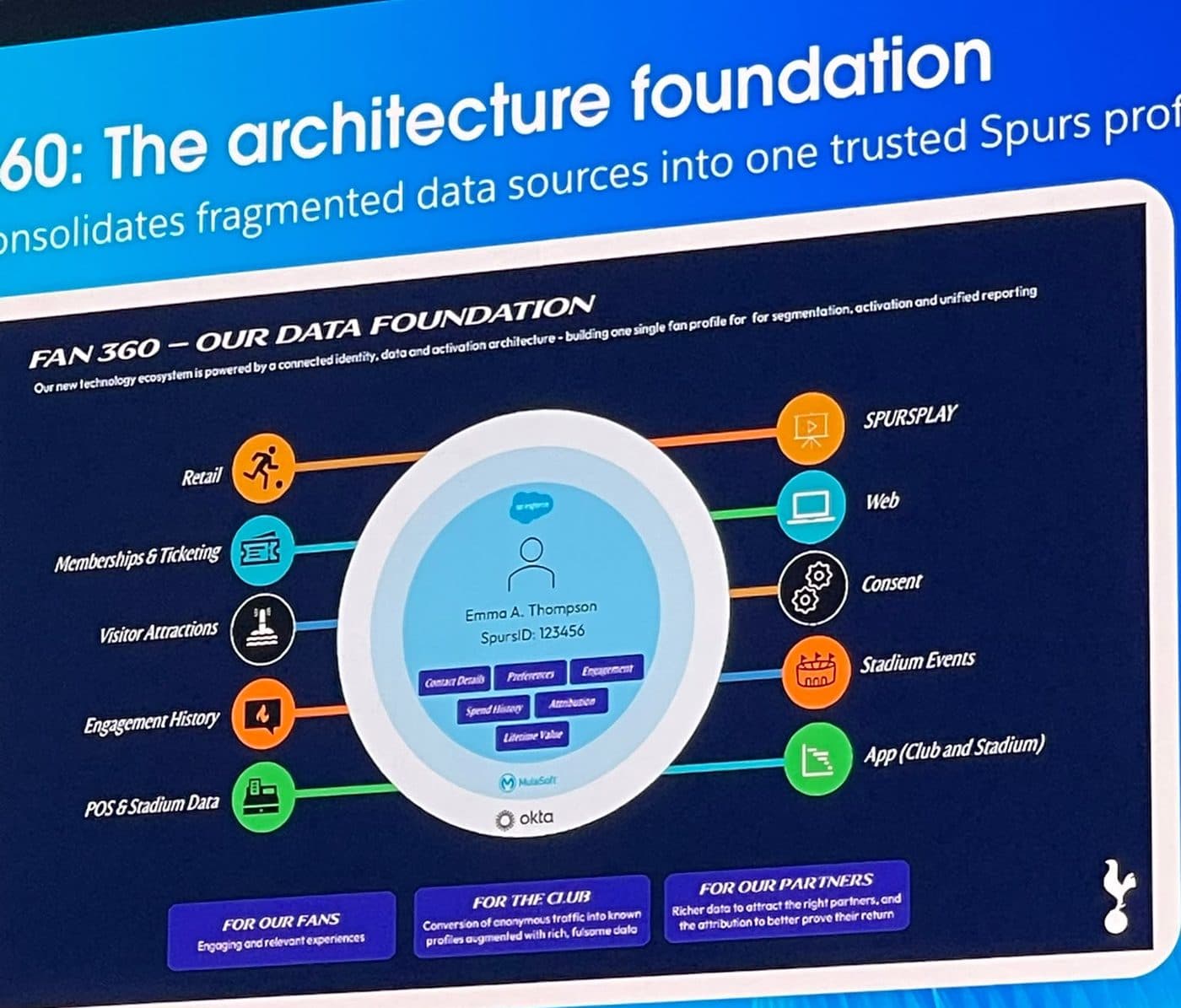
Fan 360: one trusted profile, fed by every part of the club.
Underneath, a SpursID on Okta handles identity, Data 360 is what they called the "system of context", and MuleSoft connects it in real time to the Salesforce clouds on top, plus Workday, Stripe and Ticketmaster.
The club named Salesforce its official CRM partner in October 2024. Two years on, this is what the foundation looks like. The impressive bit at the front, the personalised offer or the agent answering a fan's question, is only as good as the profile behind it. Spurs sorted identity, consent and one record first.
Five things an agent needs to understand
Another main-stage slide, headed "Trusted Enterprise Context", listed five things agents need to understand to be effective:
- •what's true across the business, in structured and unstructured data
- •how to get to that data efficiently (GraphRAG and RAG)
- •what the data means (semantics)
- •what carries over from one session to the next (memory and learning)
- •what they're allowed to see and do (governance)
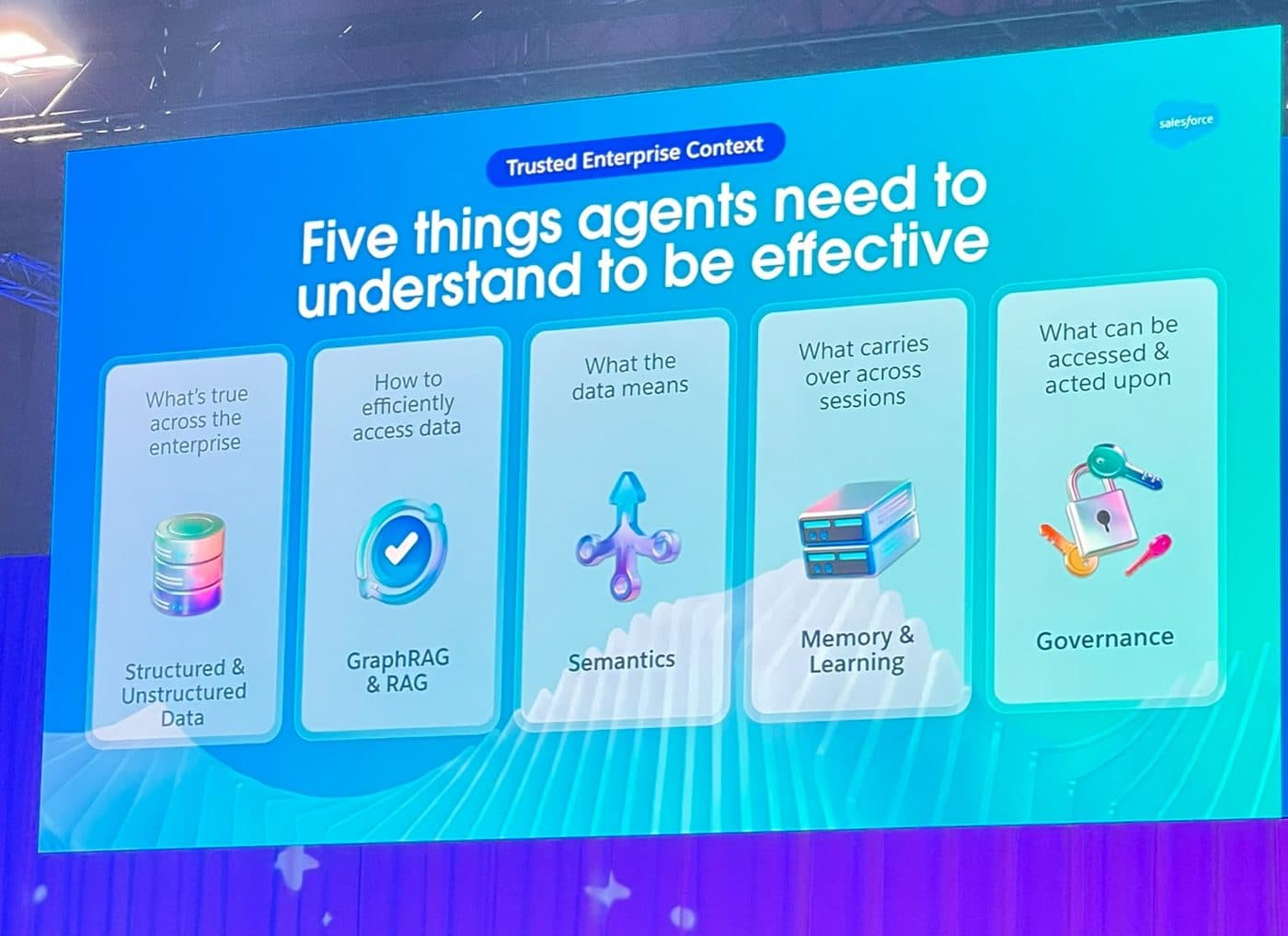
Five things agents need to understand to be effective.
Each line turns into a question a CIO or CTO can ask their team this week.
| What the agent needs | Ask your team | The answer that should worry you |
|---|---|---|
| What's true | Where is the single customer record, and who owns it? | "It depends which system you look in." |
| How to find it | Can the agent search documents and records together, with permissions applied? | "We'll give it an export." |
| What it means | Do we have one agreed definition of an active customer, of pipeline, of churn? | "Finance and sales count it differently." |
| What carries over | What does the agent remember between conversations, and for how long? | "We're not sure." |
| What it's allowed to do | What can it read, change or send without a person approving? | "Same as the admin user." |
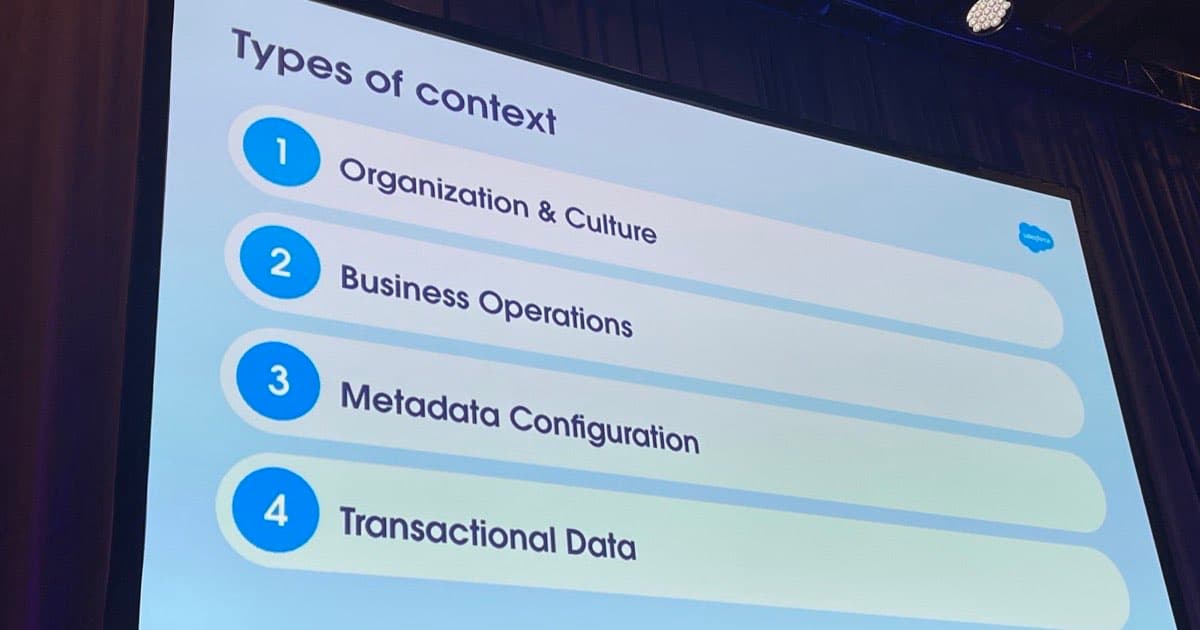
If you want to go further, I've written about the four types of context every agent needs and about agent architecture.
One more screen stayed with me: a Data 360 lineage view, tracing a segment back, step by step, to the data it came from. If an agent's decision ever has to stand up to scrutiny, from a regulator, an auditor or your own board, that's the screen you'll want.
4. Your buyers moved before your funnel did
For heads of marketing and sales, the Theatre 2 session from Danielle Grau, Senior Director of Product Management, and Tom Brennan, Lead Specialist SE, at Salesforce opened with two numbers from Forrester's research.
- •68% of B2B buyers already have a front-runner vendor in mind at the very start of their purchase process.
- •80% of the time, that front-runner wins.
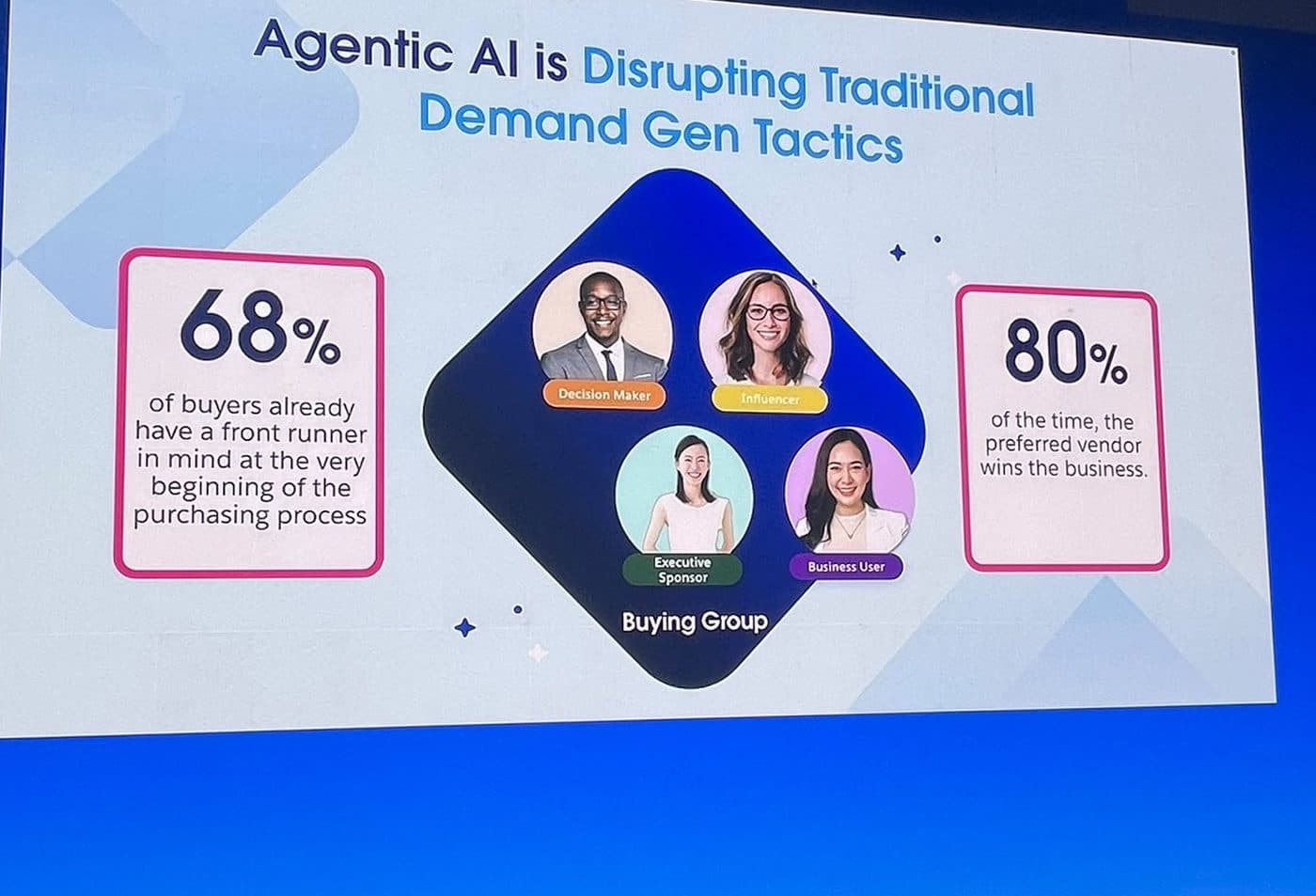
Forrester's front-runner figures, in the B2B marketing session in Theatre 2.
Read them together. If you're not the front-runner before the first sales conversation, you're most likely competing for second place. And the buyer is really a buying group, a decision maker, an influencer, an executive sponsor and the people who'll use what you sell, who formed a view long before anyone filled in a form.
Forrester also found that 94% of business buyers use AI somewhere in their buying process. The keynote made the consumer version of the point: customers now discover and decide without ever reaching your site. McKinsey's research has about half of consumers already using AI-powered search, and more than 70% of those users asking it early, top-of-funnel questions about a category, a brand or a product.
A keynote demo then showed a report I'd like every marketing director to see for their own brand. It ranked a fictional footwear brand against its competitors by how often AI answer engines mention it, how often they cite its pages as a source, and how positively they describe it.
You can do a rough version yourself this month. Write down the 20 questions your buyers ask before they buy. Put them to ChatGPT, Gemini, Copilot and Perplexity. Note who gets named, who gets cited and what's said about you. Then do it again next month.
The Buyer Engagement Agent, and the handoff again
Salesforce introduced the Buyer Engagement Agent in the same session. It does three things: two-way nurture that can engage, qualify and book meetings from any message; answers grounded in your own knowledge base; and a handoff to sales with the full context, including a transcript of the buyer's conversation.
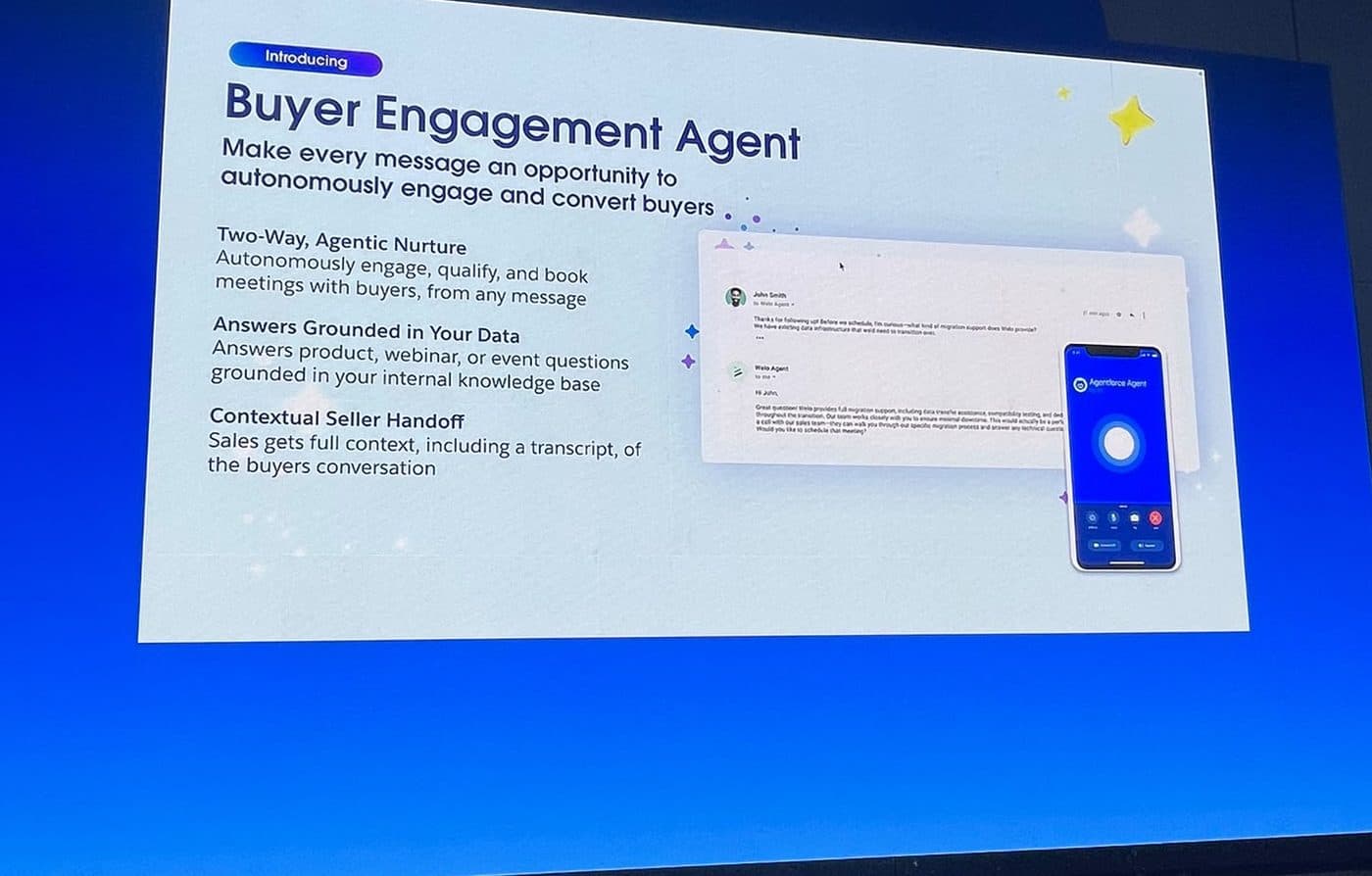
The Buyer Engagement Agent. The third box is the one to plan for.
That third one is where Immersive's line comes back. Value is won or lost at the handoff. An agent that qualifies a buyer at 9pm is worth very little if the lead then waits three days for a seller who doesn't read the transcript.
So before you switch on anything like this, write a handoff contract between marketing and sales:
- •what counts as qualified, in words both teams sign
- •what the seller receives: the transcript, the account context and who else is in the buying group
- •how fast a person responds, and who covers when they can't
- •who owns an account the agent has already spoken to
- •how you'll measure it, with meetings held and pipeline created alongside conversations started
What to do on Monday, by role
One question to ask this week, and one move for the next 30 days.
| If you're the... | Ask this week | Do in the next 30 days |
|---|---|---|
| MD or CEO | Which one workflow should AI change first, and who owns the result? | Pick it, name a business owner, and fund the people side properly. |
| COO | Where do handoffs break in that workflow today? | Map it end to end. Put AI where the work stalls, and measure what's accepted downstream. |
| CIO or CTO | The five context questions above. | Fix identity, definitions and permissions for that one workflow before adding agents. |
| Head of Marketing | What do AI answer engines say about us? | Run the 20-question check and fix the pages that get cited. |
| Head of Sales | What does a seller get when an agent hands over? | Write and sign the handoff contract with marketing. |
| Programme Director | Is our AI plan really a system implementation plan? | Add a change workstream: a baseline, champions, a stigma plan and reinforcement after go-live. |
A ten-question readiness check
Answer yes or no. Nobody's watching.
- We've named the first workflow AI should change, and a business owner for it.
- We know roughly how many of our people are avoiders, collaborators, experimenters and delegators.
- A senior leader has shown their own AI use in the open.
- We know who checks AI-assisted work at each handoff, and against what standard.
- There's one trusted customer record an agent could read.
- We can trace a number in a report back to its source.
- Permissions and consent are set before an agent goes live.
- We measure what people do differently, as well as licences bought.
- Marketing and sales have agreed what an agent hands over.
- We know what AI answer engines say about our brand.
My rule of thumb: more than three noes, and the next pound goes on people and data before another agent.
The banner was out of date. That's fine.
Every product slide on Thursday assumed an organisation that had already done the hard part: people who trust the output, one record of the customer, and a handoff that holds. Most haven't yet. It's fixable. It's mostly unglamorous work, and it's where the return comes from.
Where to start
If you're about to roll out AI or Agentforce and want an honest view of whether the organisation is ready, start with a Delivery Control Snapshot. Three days, a readout that stands up to scrutiny, and a 90-day plan with an owner against every action.
Ready to prove one workflow? Our Agentforce Pilot runs for six weeks, with guardrails and measurable outcomes. Not sure which fits? Book a 30-minute Fit Check and we'll tell you, even if the answer is that you don't need us yet.
Sources
- •Salesforce: AIforce World Tour London event page
- •SalesforceBen: Salesforce renames AIforce to SIforce (12 October 2026)
- •BCG: The formula for agentic AI value, the 10-20-70 rule (September 2026)
- •Slack: Fall 2024 Workforce Index (November 2024)
- •Forrester: Building preference is the key to winning B2B buyers (February 2026)
- •Forrester: The state of business buying, 2026 (January 2026)
- •McKinsey: New front door to the internet, winning in the age of AI search (October 2025)
- •Tottenham Hotspur: Club and Salesforce partner (October 2024)
- •Diginomica: Tottenham Hotspur's single fan record
- •Slides and stage photographed by the author at ExCeL London on 15 October 2026. Slide content belongs to the presenters.
Author

You may also like…
Frequently asked questions
What was AIforce World Tour London 2026?
Salesforce's free one-day event at ExCeL London on Thursday 15 October 2026. It brought the Dreamforce 2026 announcements, including Agentforce, Data 360 and Slack, to UK customers, with a keynote, theatre sessions, customer stories such as Tottenham Hotspur, and demos.
Why was it called AIforce, and what is SIforce?
AIforce is the name Salesforce gave its agentic integration layer at Dreamforce in September 2026, after showing it as Headless 360 at TDX in April. A few days before the London event, Marc Benioff posted on X that AIforce is now SIforce. The event branding in London still said AIforce.
What is BCG's 10-20-70 rule for AI?
BCG's rule of thumb for getting value from AI: put 10% of the effort into the algorithms, 20% into the technology and data, and 70% into changing people, the organisation and its processes. Immersive used it at World Tour London to argue that AI adoption is a behaviour change programme.
What are avoiders, collaborators, experimenters and delegators?
They are the four groups Immersive used to describe AI maturity in a team, from people who avoid AI altogether to people who hand whole tasks to it and review the result. All four usually sit in the same team, and the least mature person sets the pace, because AI value is won or lost at the handoff between them.
What do AI agents need to understand to be effective?
A Salesforce slide at World Tour London listed five things: what's true across the enterprise (structured and unstructured data), how to access that data efficiently (GraphRAG and RAG), what the data means (semantics), what carries over between sessions (memory and learning), and what can be accessed and acted on (governance).
How did Tottenham Hotspur prepare its data for AI?
Spurs built Fan 360, which consolidates retail, memberships and ticketing, visitor attractions, engagement history, and point-of-sale and stadium data into one trusted fan profile. Identity runs on a SpursID through Okta, Data 360 acts as the system of context, and MuleSoft connects it in real time to the club's Salesforce clouds, Workday, Stripe and Ticketmaster.
How is agentic AI changing B2B demand generation?
Buyers decide earlier. Forrester found that 68% of B2B buyers have a front-runner vendor at the very start of their purchase, and that front-runner wins 80% of the time. Salesforce's Buyer Engagement Agent nurtures and qualifies buyers from any message, then hands over to sales with a transcript, so the handoff between agent and seller now decides how much of that value you keep.
Where should a leadership team start with AI adoption?
Pick one workflow and name a business owner for it. Fix the data and permissions underneath it, plan the change for the people who use it, and measure how much AI-assisted work is accepted at each handoff. A three-day Delivery Control Snapshot is a quick way to get an honest baseline and a 90-day plan.